
One of the easiest ways to weaken an academic paper is not through poor writing or grammatical mistakes, but by building conclusions on evidence that cannot fully support them. This often happens without the writer realizing it. A statistic looks convincing, a journal article appears trustworthy, or a report contains a statement that perfectly matches the argument being developed. Since the evidence seems useful, it is accepted without much further thought.
The problem is that not every piece of evidence deserves the same level of confidence. Some studies are based on minimal groups of participants. Others may rely on outdated information, limited observations, or methods that are not suitable for answering the question you are researching. Even reliable publications can contain findings that you should interpret carefully rather than accept as universal facts.
Once weak evidence becomes part of your research, it quietly influences the rest of the writing process. You begin organizing paragraphs around it, searching for additional sources that appear to support it, and shaping your conclusions based on assumptions that may not be as strong as they first seemed.
Recognizing weak evidence before it becomes part of your argument is one of the most valuable research skills you can develop. It helps you produce conclusions that are balanced, well supported, and much more convincing to anyone reading your work.
Strong Sources Can Still Contain Weak Evidence
Many students assume that if an article comes from a respected journal or academic publisher, every statement inside it must automatically be reliable. While credible publications usually maintain high standards, individual studies can still have limitations.
Researchers themselves often acknowledge these limitations. They may explain that their sample size was small, that the study focused on one location, or that additional research is needed before broader conclusions can be drawn. These details are not signs of poor research. They simply remind readers that every study has boundaries.
Ignoring those boundaries can create problems. A finding that accurately describes one specific group may not apply to every population or situation. If the writer overlooks these differences, the evidence begins supporting conclusions that extend beyond what the research actually demonstrated.
Good academic writing pays attention not only to what researchers discovered but also to the conditions under which those discoveries were made.
Evidence Should Match the Question You’re Trying to Answer
One reason weak evidence enters research papers is that students focus on whether a source is interesting instead of whether it is relevant.
Imagine writing about study habits among university students and finding a detailed article about learning strategies used in primary schools. The research may be carefully conducted and full of useful information, but it does not necessarily answer your own research question.
Evidence becomes strong when it fits the purpose of your paper. This includes considering who participated in the study, where the research was carried out, and whether the methods relate to the issue you are investigating.
Before adding a source to your notes, ask yourself whether it genuinely helps answer your research question. If it only connects to your topic in a general way, it may not deserve a central role in your argument.
Be Careful With Evidence That Sounds Too Perfect
Sometimes you come across a statistic or quotation that appears to support your argument perfectly. It says exactly what you hoped to find, making it tempting to place it immediately into your paper.
This is precisely when you should slow down.
Evidence that fits your expectations perfectly can encourage confirmation bias, the tendency to accept information that agrees with your existing opinion while paying less attention to evidence that challenges it. Without realizing it, you may begin collecting support for a conclusion you have already chosen rather than allowing the research to guide your thinking.
Whenever a source seems unusually convenient, take a closer look. Check how the information was collected, whether the conclusion reflects the data fairly, and whether other studies have reached similar findings.
Being cautious with evidence that strongly supports your opinion helps create research that is balanced instead of selective.
One Piece of Evidence Rarely Tells the Whole Story
Academic topics are often more complex than they first appear. A single study may provide valuable insight, but it rarely offers the complete picture.
For example, one research project might report positive effects from a particular educational method. Another study could find smaller benefits under different conditions, while a third identifies limitations that were not considered in the earlier work.
Looking at only one of these studies creates an incomplete understanding. Looking at all of them together provides a much stronger foundation for analysis.
Rather than asking whether one source is enough, ask whether your evidence represents the broader discussion within the field. Conclusions become more reliable when they are supported by multiple pieces of evidence instead of relying heavily on one impressive-looking study.
Weak Evidence Often Reveals Itself Through Small Details
Students sometimes expect weak evidence to contain obvious mistakes. More often, the warning signs are subtle.
A study may involve very few participants, making it difficult to apply the findings more broadly. The research might be several decades old in a rapidly changing field. Important information about the research process may be missing, or the authors may acknowledge limitations that reduce the certainty of their conclusions.
None of these issues automatically make a source unusable. They simply indicate that the evidence should be interpreted carefully and supported with additional research whenever possible.
Developing the habit of noticing these details allows you to evaluate evidence more thoughtfully before it becomes part of your final conclusions.
Ask Questions Before Accepting Any Evidence
One habit that separates careful researchers from rushed ones is that they pause before accepting information at face value. Instead of immediately adding a study to their paper, they spend a few moments asking simple but important questions.
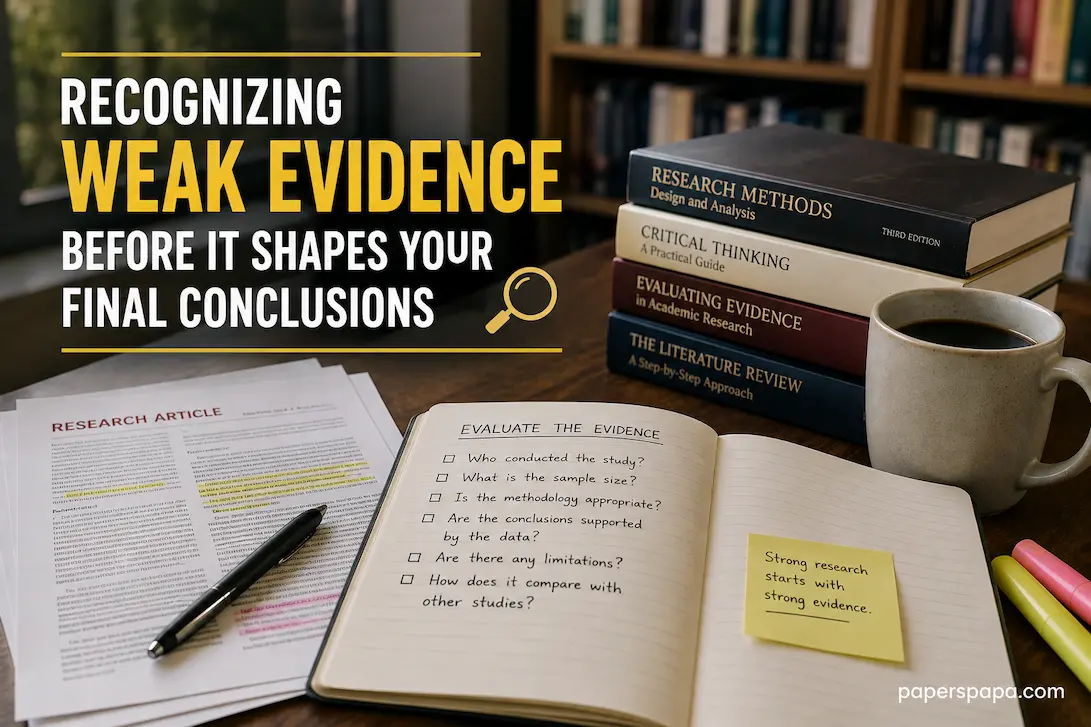
Who took part in the research? Was the sample large enough to support the conclusion? Does the evidence directly relate to the issue being discussed? Has the author explained any limitations? These questions do not require advanced research skills, yet they often reveal whether the evidence deserves a central place in your argument.
It is also helpful to compare the findings with other reliable sources. If several independent studies reach similar conclusions, your confidence in the evidence naturally increases. If one article stands alone while others report different results, it deserves a closer examination before influencing your final conclusions.
Developing this questioning mindset makes your research more thoughtful and reduces the risk of building important arguments on weak foundations.
Weak Evidence Can Affect an Entire Paper
A single weak source rarely stays isolated. Once it becomes part of your outline, it often influences several sections of your paper.
You may use it to introduce your topic, support your main argument, explain your findings, and even shape your conclusion. If that evidence later proves unreliable or only partially relevant, much of your discussion becomes difficult to defend.
This is why evaluating evidence early is so important. It is much easier to replace a questionable source before writing begins than to rewrite multiple sections after discovering a problem during editing.
Strong papers are not created by adding evidence quickly. They are built by selecting evidence carefully and making sure every important claim rests on reliable support.
A Quick Comparison Between Strong and Weak Evidence
The difference between reliable and questionable evidence is often easier to recognize when you focus on a few practical characteristics.
| Strong Evidence | Weak Evidence |
|---|---|
| Directly answers the research question | Only loosely relates to the topic |
| Supported by transparent research methods | Provides little explanation of how findings were reached |
| Fits within the broader body of research | Conflicts with most evidence without sufficient explanation |
| Acknowledges limitations honestly | Makes broad claims with little supporting detail |
Looking for these characteristics while reading can help you judge sources more confidently without relying only on the reputation of the publication.
Do Not Confuse Self-Confidence with Correctness
Some research papers use confident language to make their findings sound irrefutable. While clear writing is an advantage, self-confidence is not the same as solid evidence.
Pay attention to how conclusions are confirmed. Are they based on rigorous analyses, or do they go beyond existing evidence? Good researchers focus on the implications of their findings and the direction for further research.
Equally important is the realization that academic knowledge evolves. New evidence can confirm, refine, or challenge previous findings. An open attitude ensures that your research remains balanced and prevents you from prematurely clinging to a particular viewpoint.
The goal of research is not to find the most convincing-sounding evidence, but to discover truly well-substantiated evidence.
Conclusion
Excellent academic work is the result of careful planning. It results from well-considered decisions made before you write the final version. Every source you accept, every statistic you cite, and every study you use to support your position influences the direction of your argumentation. But if this foundation is not solid, even well-written paragraphs cannot convince the reader. Spending more time evaluating evidence during the research process is one of the most valuable investments. We can arrive at more robust and accurate conclusions if we look beyond sensational headlines, evaluate research methods, acknowledge the limitations of the research, and compare findings from various sources.
The best researchers are not those who collect the most evidence, but those who can distinguish which evidence is reliable and which requires caution. This ability makes research results not only more accurate but also more balanced, credible, and academically convincing.
Frequently Asked Questions
Should I avoid limited literature?
No. Almost all research has limitations. The key is to understand these limitations, not to draw unreasonable conclusions.
Is new evidence better than old evidence?
Not necessarily. Although recent research is useful, especially in rapidly changing fields, well-designed earlier studies with follow-up research remain of great value.
What if two reliable sources contradict each other?
In that case, do not immediately choose the correct source. Compare the research methods, participants, and research locations. Investigating the reasons for the differences is often more interesting than simply determining which source is correct.
May weak evidence be mentioned in an article?
Yes, as long as it has practical relevance. You can use it as an example of the limitations of research results, conflicting studies, or topics that require further research. The goal is not to prove that it is evidence, but to demonstrate that it is sufficient to make us aware of its limitations.