
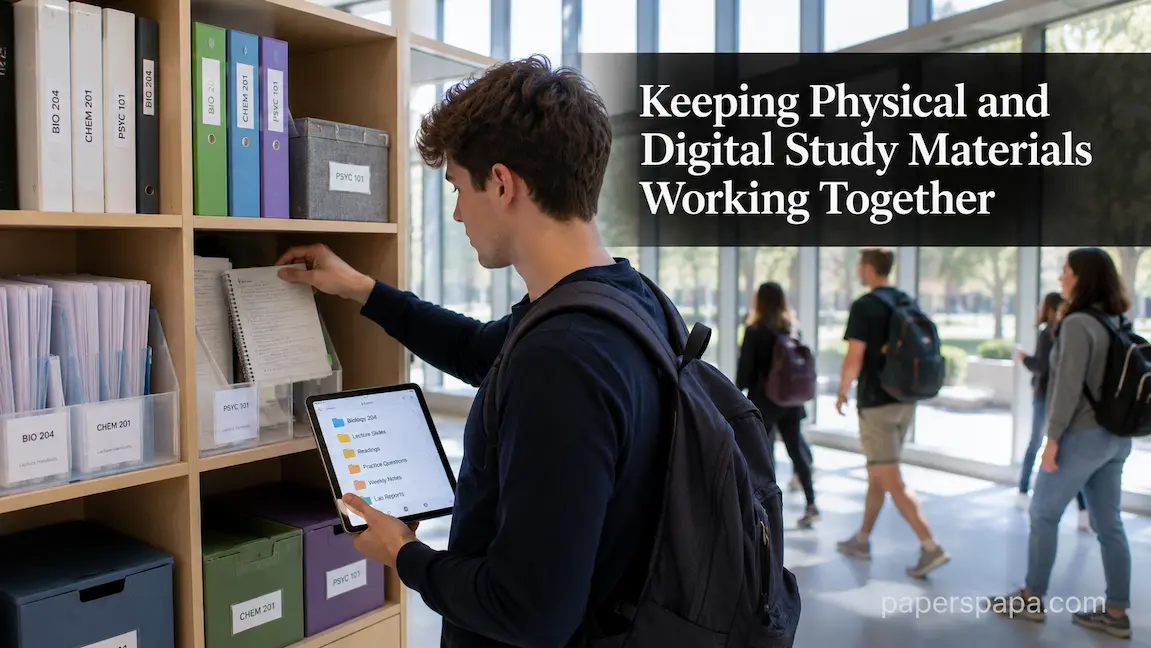
Different students have different learning styles. Some find it easier to understand notes in a notebook than to read course material on a laptop or save everything in a cloud folder. In fact, many students use both electronic and paper tools weekly. They keep handwritten notes and downloaded PDFs together, printed exercises and online articles together, and even print assignment instructions from emails to review and revise while studying. The challenge is not to choose which method to use, but rather how to seamlessly integrate them.
Problems often arise when paper and electronic materials grow at different rates. For example, useful information might be in a notebook but never linked to the data on the computer. You might have downloaded an important article months ago but forgotten about it without ever finding it again. Students often remember seeing this information before but can no longer recall where. Such behavior costs time searching instead of learning. It is not our goal to convert everything into electronic documents or replace paper notebooks with tablets. Each format has its advantages and can help people learn in different ways. Finding, saving, and accessing digital resources on multiple devices is more convenient, while handwritten notes help maintain focus. Do not view them as opposites, but as two parts of the same learning process.
A balanced approach ensures that important information remains connected, regardless of where it is stored. Switching between notebooks and digital files does not feel disruptive. This makes exam preparation much easier.
Give Every Subject One “Home”
Many students organize their material by style rather than by subject. Handwritten notes go in one folder, downloaded files in another, printed handouts in yet another, and practice questions in another. This organization may seem neat, but it often makes studying more difficult because it scatters resources related to the same subject across different places.
A simpler approach is to place each subject at the center of your study group. All written, printed, or electronic material must relate to that subject. For example, when you start reviewing biology, you need to know immediately where your notebooks are, where your slides are stored, and where other reading material is located.
By prioritizing the subject rather than the type of material, you will not spend too much time searching. Even if the formats differ, it is easier to locate all the material belonging to the same course.
Let the Two Formats Work Together
If electronic resources can help you, you do not need to write every detail in your notebook. Similarly, you do not need to replace your handwritten explanations and summaries with electronic files. Instead of constantly noting down the same information, let each format add new content.
For example, lecture slides can show detailed images and explain terminology, while your notebook can contain your questions, answers, and reminders. These two tools can help each other review the material. Electronic material provides all the information you need, while handwritten notes help you remember what to pay extra attention to in class.
This combined use of two formats also reduces unnecessary work. You are no longer just copying existing information, but noting down ideas that help you understand better.
Build Connections While the Topic Is Fresh
A habit we often forget is to make connections immediately after learning new knowledge. Imagine you have just finished a lecture and receive the presentation in the evening. Do not simply save the file; Instead, note where it is located in your notebook, or if the electronic file corresponds to your handwritten notes, label the file with the course number.
These small connections may seem unimportant now, but they will be invaluable when you review the material weeks later. You won’t have to guess which notes belong to which presentations because the connections are already clear.
This habit also prevents them from becoming scattered during a busy semester. New learning materials are no longer isolated collections that are difficult to integrate, but instead flow naturally with your existing learning methods.
A Better Goal Than Having Everything in One Place
Many students waste time trying to keep all their learning materials in one file, which is unnecessary. They print documents, rewrite electronic notes, or scan handwritten pages to ensure everything is consistent. While consistency is important, it does not have to be completely uniform.
Instead of striving for uniformity, striving for accessibility is a more meaningful goal. Not all learning materials need to be identical. It is sufficient to understand their place in the learning system and how they interact with other learning materials. When retrieving information is straightforward and fast, digital and physical tools can work together as a well-organized system.
A Small Habit That Prevents Big Problems Later
Attending three lectures a day is insane. From handwritten notes to reading guides you receive via email, online lectures, and two presentations you download from the university website: you have a mountain of material to deal with. Theoretically, all the material is there, but it is not connected. A month later, when you review it, you still know what you learned, but you cannot immediately recall which file belongs to which note.
Now consider how you would approach the same thing differently. After every lecture, you can link all the material together in a few minutes. Write the titles of the lectures in your notebook and assign your digital folders the same names. Optionally, add extra reading material to your weekly study materials. By the time of the exams, you will have already linked all relevant study materials, making it much easier to review the material.
The key is not how much work you put into it, but the timing. Organizing material while it is still fresh in your memory is much easier than struggling to make those connections weeks later.
Use a Notebook to Manage Your Digital Files
Many students think that notebooks are entirely different from computers and the internet. In reality, it is more accurate to view them as the starting point of your learning methods. You should be able to locate electronic material related to every lesson, topic, or chapter you have written down by hand. This material can consist of PDFs, presentations, research papers, or recorded lectures.
You don’t need to write much in your notebook. Usually, it is sufficient to simply note down the subject of the lecture, the file name, or the chapter number. These simple notes connect paper and electronic material, allowing you to switch between them easily.
Your notebook is more than just a place to take notes. It is more like a kind of map that allows you to locate everything related to a subject, regardless of where the material is stored.
Ask Yourself One Question at the End of Every Week
Before you finish your last study session of the week, choose a topic you have just studied and try to locate all related resources. Look up your handwritten notes, open the electronic files, look for exercises, and see if you can easily locate more reading material.
If the task takes only a minute or two, your studies are likely progressing well. If you spend a long time searching through downloads, emails, or various folders, the problem does not lie with your memory. This means that your paper and electronic materials are gradually growing apart rather than becoming integrated.
By performing this simple task repeatedly, you can quickly identify and solve problems while they are still easy to remedy.
Do Not Strive for Perfection, But Build a Cohesive System
Students sometimes spend too much time deciding whether studying on paper or online is better. In real life, they can both work really well if they work together instead of against each other for your attention. The best ways to study don’t usually depend on just one method. They are designed to make it simple to find, understand, and use data whenever it’s needed.
As your classes get harder, the number of study tools you need will naturally rise. Small problems with organization don’t have to turn into big problems before tests and assignments if you keep these tools linked through simple, regular habits. When your notes, digital files, and reference materials all work together, you can focus on learning instead of looking for things, and you can start each study session with confidence instead of doubt.
Frequently Asked Questions
Do I need to digitize all my handwritten notes?
Unless there is a very compelling reason, you do not need to. Many students still find handwritten notes useful, because writing helps them concentrate and understand the material better. The most important thing is to link them to your electronic tools, not to throw them away.
What if I use multiple tablets or phones to study?
Keep group names and course structures as consistent as possible across all your devices. If you consistently use the same system, you won’t have to worry about where your files are.
Can I use both paper and online resources for the same course?
Absolutely. In fact, many students learn better by using both sources simultaneously. You can capture your explanations and thoughts with handwritten notes while simultaneously gaining quick access to digital tools such as handouts, supplementary literature, and references.