
Students frequently envision significant issues, including inaccurate citations, unreliable sources, or a lack of evidence, when contemplating feeble academic writing. Although those concerns are undoubtedly significant, numerous papers experience a decline in their effectiveness due to an entirely distinct factor. The repetition of minor writing habits throughout the document gradually diminishes the impact of otherwise solid research. While they may appear innocuous in isolation, their combination can result in a well-researched paper that is difficult to comprehend, repetitive, or uncertain.
These behaviors are rarely intentionally formed. Writers become accustomed to specific methods of articulating ideas, which is why the majority of them appear. You may begin paragraphs with similar phrases, rely on the same transition words, or qualify every statement with superfluous caution. The pattern frequently remains undetectable until the paper is read in its entirety, as each sentence functions adequately on its own. It is not always necessary to acquire sophisticated writing strategies to enhance academic writing. At times, it is as simple as observing these recurring behaviors before they become ingrained in every page. Consistently making minor adjustments can significantly bolster an argument, surpassing the addition of an additional source or the rewriting of isolated paragraphs. Readers concentrate on the evidence rather than the writing habits that surround it, which results in a more comprehensive discussion.
When Each Point Appears to Be Less Certain Than It Is
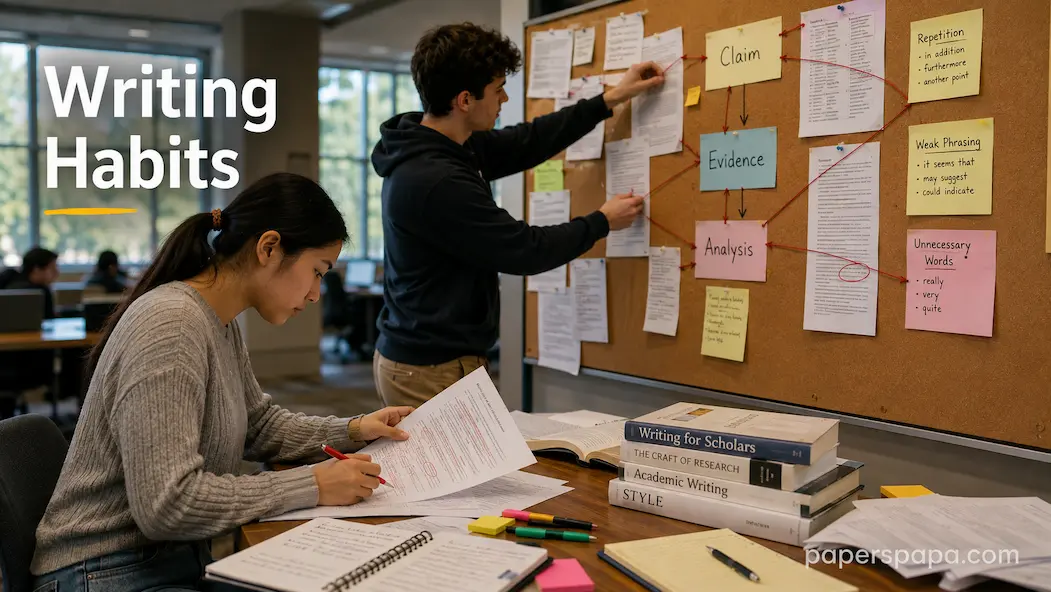
Many writers are so preoccupied with the appearance of objectivity that they fail to recognize that they undermine their own arguments. In academic writing, expressions such as “it may possibly indicate,” “it seems,” “it could be suggested,” and “perhaps” are significant when there is genuine ambiguity. Nevertheless, their inclusion in nearly every paragraph can unintentionally diminish the persuasiveness of well-supported conclusions.
Good academic writing should reflect the strength of the available evidence. There is typically no necessity to encircle each sentence with cautious language when a conclusion is substantiated by numerous reliable studies. Readers anticipate impartiality, but they also anticipate assurance when the evidence unambiguously supports a particular viewpoint. This does not entail the ability to write with complete certainty in every circumstance. Rather, employ circumspect language solely when it accurately reflects the research’s constraints. Allow stronger evidence to speak with the requisite confidence, while preserving cautious language for genuinely uncertain findings.
A Habit That Readers Observe Prior to Writers
Repetition is not limited to the repetition of concepts. It is also present in sentence openings, transition phrases, and common expressions that are subtly interspersed throughout a paper. Additionally, a writer may begin several segments with the phrases “Furthermore,” “In addition,” or “Another significant point is.” Although none of these phrases are incorrect, the cadence is predictable due to the frequent repetition.
Readers frequently identify this pattern prior to the author, as the author is already cognizant of the paper’s intended message. Readers encounter each phrase for the first time and readily recognize the repetition, while the repeated wording fades into the background during the drafting process. One effective editing strategy is to assess only the first sentence of each paragraph. By examining the opening sentences in conjunction, it becomes significantly simpler to recognize recurring patterns. Typically, the introduction of more natural variation is a straightforward task once they become visible.
Unnecessary Explanation Can Veil Strong Evidence
Many times, writers are so eager to substantiate their arguments that they present the same evidence in various methods. They continue to reiterate the conclusion in multiple sentences after presenting a well-supported study or a convincing statistic, as they are concerned that readers may not fully comprehend its significance.
In reality, writers frequently achieve the opposite effect by using superfluous repetition. Such repetition decelerates the discourse and renders the argument appear less focused. Readers typically comprehend robust evidence when they present it clearly and relate it directly to the research question. Further clarification should improve understanding instead of repeating what has already been said. It is important to cultivate the ability to recognize when to cease writing. Inquire as to whether the subsequent sentence authentically introduces a new concept after presenting evidence and elucidating its relevance. The paragraph may be strengthened by concluding earlier if it merely reiterates the previous point.
Instead of Focusing on Individual Errors, Seek Patterns
The primary objective of the majority of editing sessions is to rectify a single sentence at a time. Grammar, punctuation, spelling, and citations are all important, but they rarely reveal behaviors that are present throughout the entire paper. Searching for recurring behaviors rather than isolated errors is a more effective editing strategy.
For instance, you may observe that nearly every paragraph includes an unnecessary introductory phrase, that numerous sections reiterate the same explanation, or that your most compelling assertions are consistently followed by language that diminishes their impact. These are not errors in the conventional sense; however, they impact the persuasiveness of the paper. The process of revision becomes more strategic when one begins to seek patterns rather than the individual sentences. You resolve issues that enhance the quality of the paper from the outset, rather than making hundreds of unrelated corrections.
Read a Single Time With Only One Habit in Mind
When you try to enhance all aspects of a project in a single editing session, you often overlook issues. Your focus transitions from grammar to citations, then to formatting, and ultimately to sentence structure. Consequently, the more significant writing practices frequently go unnoticed due to the fact that your attention is constantly shifting. A more effective approach is to assign a single objective to each review and disregard all other activities until the reading is finished.
For instance, a single reading session may concentrate solely on words that are repeated. Another option is to focus on whether each paragraph substantiates the primary argument. Transitions between sections may be examined in a subsequent review without regard for grammar or punctuation. The recognition of patterns is significantly facilitated by the focus on a single type of issue, as your attention is not diverted to a multitude of distinct concerns.
Two Differing Outcomes from a Single Paragraph
Consider a paragraph that begins with a concise assertion and a recent study substantiates it. The writer reiterates the same point three times, albeit with subtly altered language, rather than proceeding to analysis. Although the paragraph expands, it provides readers with minimal new information beyond what the introductory sentences initially established. Despite the reliability of the information, the argument appears to be proceeding at a slower pace.
Consider the possibility of rewriting the same paragraph by eliminating the redundant explanations and substituting them with a single, well-reasoned observation regarding the significance of the evidence. The paragraph is immediately fortified by the addition of each sentence, which contributes something novel. The superfluous repetition has been replaced with meaningful analysis; nothing significant has been removed. This type of enhancement frequently generates a more substantial effect than the inclusion of an additional quotation or reference. Strong writing is not solely evaluated by the quantity of information it contains; it is also evaluated by how effectively that information is conveyed.
A Simple Habit That Enhances Each New Draft
Pick a random paragraph and read it as if it were the only one that would ever be seen before you finish writing for the day. Inquire as to whether the evidence genuinely supports the argument, whether it makes a single clear point, and whether each sentence has earned its place. This brief exercise requires only a few minutes, yet it gradually alters the manner in which you compose future paragraphs.
Slowly, you develop the ability to observe habits as they occur, rather than waiting until the editing stage. Unnecessary explanations are less frequent, repeated phrases are simpler to identify, and paragraphs acquire a more defined sense of purpose. Rather than implementing significant changes at the conclusion of a project, one cultivates effective writing habits through consistent awareness.
The Protection of Strong Arguments is Guaranteed by Small Daily Decisions
Readers seldom observe the moment a paper becomes persuasive. Rather, the discourse is well-supported, balanced, and unambiguous from the outset. The final editing session does not result in a single significant enhancement, but rather dozens of minor writing decisions that contribute to the overall impression. Each purposeful sentence, focused paragraph, and meticulously selected explanation quietly fortifies the overall argument.
Consequently, it is imperative to prioritize your routines in conjunction with your research. While reliable sources and thoughtful analysis are still necessary, their full potential is only realized when the reader’s attention is no longer diverted by superfluous repetition, weak phrasing, and distracting patterns. The most formidable academic writers frequently excel at preventing minor habits from undermining robust ideas, rather than just possessing knowledge about a subject.
FAQs
1. What is the most effective method for determining whether I am reiterating myself?
A valuable indicator is when two sentences that are in close proximity convey nearly identical content through distinct language. The paragraph may be more effective without the sentence if its removal does not compromise the reader’s comprehension.
2. Is it necessary for each paragraph to include an equal quantity of evidence?
Not necessarily. Certain theories require more support than others. Instead of a predetermined pattern, the amount of evidence should match the complexity and significance of the argument you are making.
3. Is it an issue if I have preferred transition words?
No, but the writing may appear predictable if it relies on the same few expressions throughout the paper. Before submitting your work, it is simple to identify this habit by reading the opening sentence of each paragraph together.