
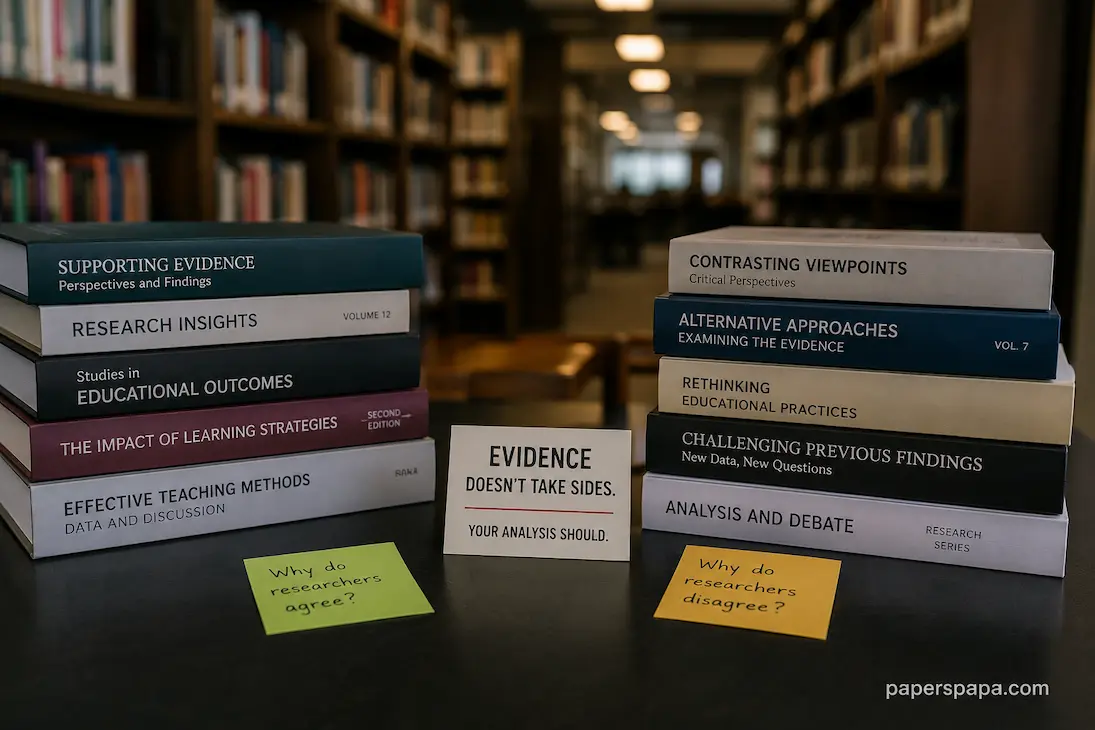
One of the most valuable skills in academic research is learning how to handle disagreement. No matter what subject you study, you will eventually come across two reliable sources that reach different conclusions. One researcher may argue that a particular teaching method improves student performance, while another finds little evidence of any long-term benefit. Both studies may be well designed, published in respected journals, and supported by credible data. The question is, what should you do when they disagree?
Many students respond by choosing a side almost immediately. They read the first convincing article, decide it matches their opinion, and begin searching for more sources that support the same viewpoint. Although this approach feels easier, it can weaken the quality of the research. Instead of evaluating the evidence, the writer begins collecting confirmation for a conclusion they have already reached.
Academic writing works best when conclusions develop from the evidence rather than the other way around. Comparing conflicting sources with an open mind allows you to understand why researchers disagree, identify the strengths and weaknesses of different arguments, and build a discussion that is balanced instead of one-sided.
The goal is to take a position at some point. It is to delay that decision until you have examined the available evidence carefully. Doing so often leads to stronger arguments and a more thoughtful final paper.
Disagreement Is Normal in Academic Research
Students are sometimes surprised when respected researchers reach opposite conclusions about the same topic. They assume one study must be correct and the other must be flawed. In reality, disagreement is a normal part of research.
Different studies often examine different groups of people, use different methods, or collect information under different conditions. Because of these differences, their findings may not match perfectly even though both studies were conducted carefully.
For example, one researcher may study university students in urban areas, while another focuses on adult learners returning to education after several years. Even if both studies investigate the same teaching strategy, the results may differ because the participants are different.
Understanding these differences helps you move beyond the idea of searching for a single “correct” answer. Instead, you begin to ask why the results differ and what those differences reveal about the topic.
Read the Entire Argument Before Forming an Opinion
It is surprisingly easy to form an opinion after reading only an abstract or the conclusion of a research paper. Strong language, impressive statistics, or confident recommendations can quickly influence your thinking.
However, research papers are much more than their conclusions. The methods, sample size, limitations, and data collection process often explain why the researchers reached their findings.
If you form an opinion too early, you may interpret later evidence unfairly. You may overlook weaknesses in the first study while becoming overly critical of studies that disagree with it. This happens naturally because people tend to protect opinions they have already formed.
A better approach is to treat every source as incomplete until you have compared it with other credible research. Waiting before making a judgment gives each study an equal opportunity to contribute to your understanding.
Look Beyond the Conclusion
Many students compare sources by reading only the final section of each paper. While conclusions are important, they rarely provide a complete picture.
Two studies might appear to disagree when you look at their conclusions alone. Once you examine the research methods, however, the difference becomes much easier to understand. One study may have followed participants for several years, while another measured results after only a few weeks. One may have included hundreds of participants, while the other relied on a much smaller sample.
These details matter because they help explain whether the disagreement comes from genuine differences in findings or simply from different research designs.
Instead of asking, “Which conclusion is right?” try asking, “What factors may have influenced these different outcomes?” This shift encourages more profound analysis and leads to more balanced academic writing.
Keep Your Notes Neutral in the Beginning
The way you take notes can influence the way you evaluate evidence. Students often write comments such as “This study proves…” or “This article is clearly better.” While these statements may seem harmless, they can push you toward one side before you’ve completed your research.
A more useful habit is to write neutral summaries. Record what each source found, how the study was conducted, and any limitations the authors mentioned. Avoid judging the evidence too quickly.
You can also leave yourself questions instead of conclusions. For example, you might note, “Why did this study produce different results from the previous one?” or “Does the sample size explain the difference?” These questions encourage further investigation instead of early decision-making.
By keeping your notes objective, you create space for your argument to develop naturally as more evidence becomes available.
Focus on Explaining Differences Instead of Declaring Winners
One of the biggest misconceptions in academic writing is that every disagreement must end with one study being declared correct and another being dismissed.
Often, conflicting findings can exist at the same time because they apply to different situations. A teaching strategy might work well in small classrooms but produce weaker results in larger ones. A healthcare intervention could be highly effective for one age group while showing limited benefits for another.
When you explain these differences instead of forcing a single answer, your discussion becomes more informative and more credible. Readers gain a deeper understanding of the complexity of the topic rather than a simplified argument that ignores important evidence.
Strong academic papers often foster disagreement. Instead, they help readers understand why disagreement exists and what they can reasonably conclude from the available research.
Compare Evidence Instead of Comparing Authors
When students find two conflicting studies, they sometimes decide which one to trust based on the reputation of the author or the university where the research was conducted. While credibility certainly matters, it should not be the only factor guiding your judgment.
A more useful approach is to compare the evidence itself. Look at how the researchers gathered their information, whether the sample was appropriate, and whether the conclusions match the data presented. A well-known researcher can still produce a study with limitations, while a less familiar author may contribute valuable findings.
You should also pay attention to whether the studies are asking the same question. Two papers may appear to disagree when, in reality, they are investigating different aspects of a larger issue. Recognizing these differences helps you avoid creating conflicts that do not actually exist.
The strongest academic discussions develop from carefully examining evidence rather than deciding which author seems more convincing at first.
A Simple Way to Compare Conflicting Studies
When several sources disagree, organizing them side by side often reveals patterns that are difficult to notice while reading them individually.
| Compare This | Questions to Ask |
|---|---|
| Research objective | Are both studies trying to answer the same question? |
| Participants | Were the same types of people included? |
| Research method | Did both studies use similar methods? |
| Time period | Were the studies conducted under similar conditions? |
| Limitations | Did the authors mention factors that may affect the results? |
Looking at these details helps you understand whether the disagreement comes from genuine differences in evidence or from differences in how the research was carried out.
This approach also makes writing easier because your discussion becomes based on observable facts rather than personal opinions.
Maintain Your Curiosity Until Convincing Evidence Remains
One of the most common mistakes in learning is prematurely replacing curiosity with certainty. If you become emotionally attached to a hypothesis, it becomes difficult to assess new information objectively.
Excellent researchers maintain their hunger for knowledge, even after reading multiple excellent articles. They continue to ask questions, search for patterns, and consider whether other explanations align better with the existing evidence.
Curiosity also benefits your writing skills. Instead of presenting a viewpoint as absolute truth, you show the reader how different pieces of evidence relate to one another. This makes the discussion more rigorous, rather than argumentative.
Being willing to change your mind is not a weakness, but rather a hallmark of excellent academic research.
Mistakes that Harm the Credibility of Source Comparisons
Comparing conflicting sources of information is not difficult, but certain tendencies can lead to biased judgments.
Some students focus only on the most recent research and neglect the evaluation of previous findings. Some ignore research that contradicts their views, even if that research is strongly substantiated. Another common mistake is interpreting an article as sufficient evidence to settle complex academic debates.
It is just as important not to compare data from entirely different studies. Studies conducted in different countries, age groups, or at different times will naturally lead to different conclusions. We must not ignore these differences, but rather acknowledge them.
By taking the extra effort to understand the context of each study, we can often conduct a more balanced and convincing debate.
Conclusion
Contradictory data do not hinder excellent research; on the contrary, they offer opportunities to deepen our understanding of a subject. Take the time to identify the cause of the disagreement rather than rushing to determine which study is correct. Sometimes, seemingly contradictory points can stem from subtle differences in methodology, participants, or context.
Academic authors do not collect references to confirm preconceived ideas. They are guided by the evidence. Balanced, credible, and more convincing research arises from careful comparison of studies, an open attitude, and a focus on the quality of the evidence, not on personal biases. The next time you encounter two reliable sources that point in different directions, do not rush to determine which one is right. Often, it is much more useful to understand the reasons for the debate than to take sides.
Frequently Asked Questions
What if the sources differ? Should I take sides?
No. Sometimes data can help us make nuanced judgments, respecting the strengths and weaknesses of multiple perspectives. In academic writing, careful consideration is often more valuable than immediately taking a stance.
What if two studies are equally convincing?
If both studies are credible and supported by sufficient evidence, explain why they yielded different results. Differences in participants, methods, or research environments can be significant and strengthen your argument.
Should I ignore studies that do not support my argument?
No. If you have sufficient refuting evidence, you should include it in your article. This makes your text more convincing and shows that you have viewed the issue from multiple perspectives, rather than merely presenting a one-sided viewpoint.