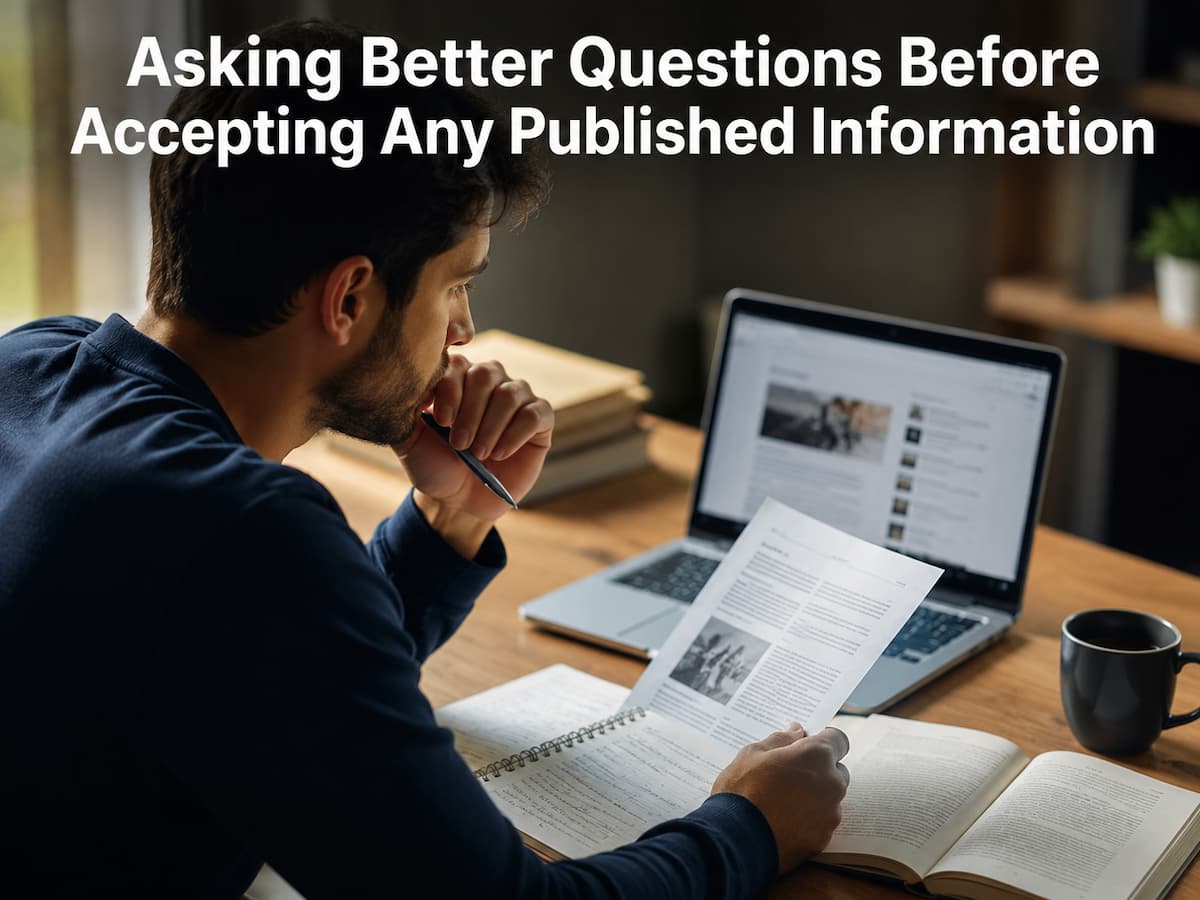
Most people grow up with the idea that the content of books, newspapers, magazines, or websites is likely verified and therefore accurate. However, although many publishers adhere to strict editorial guidelines, publication does not guarantee the accuracy of the information. Articles may contain inaccuracies or outdated information, omit essential details, include actual errors, or draw conclusions that new evidence later refutes.
This is especially true in the digital world, where anyone can publish something online within minutes. Experts sometimes write multiple articles after months of research. Some articles are based on rumors, while others are based on unverified direct quotes or claims. For beginners, it can be difficult to distinguish these articles because they all look very professional. The best approach is not to memorize specific websites but to develop the habit of asking relevant questions before adopting information. Asking well-thought-out questions prevents hasty conclusions and promotes critical thinking. They clarify the source’s content, reasoning, and the strength of the supporting evidence.
The First Question: Who Created This Information?
The first step is identifying the source behind the information. Every article, report, video, or research paper has an author or organization responsible for its content. This doesn’t mean unknown writers should automatically be ignored. Instead, ask questions such as:
- Is the author identified?
- What experience or expertise do they have?
- Does the organization have a reputation for careful publishing?
- Is the purpose educational, commercial, or promotional?
Knowing who created the content provides important context before evaluating the information itself.
Ask Why the Information Was Published
Every publication has a purpose. Some aim to educate readers. Some summarize research. Some sell products. Others persuade readers to support a particular viewpoint. Understanding the purpose helps you interpret the content more fairly.
For example, a company’s product page naturally highlights the strengths of its products. That doesn’t necessarily make the information false, but it reminds readers that the content has a marketing objective. Educational institutions and government agencies usually publish information for different reasons, often focusing on explanation rather than persuasion. Whenever possible, identify the intended purpose before accepting the conclusions.
Look Beyond the Headline
Headlines are designed to attract attention. Unfortunately, they sometimes simplify complex topics or emphasize the most surprising part of a story. Instead of forming an opinion immediately, continue reading. Ask yourself:
- Does the article actually support what the headline claims?
- Are important limitations explained later?
- Does the conclusion match the evidence presented?
Many misunderstandings happen because people share or remember headlines without reading the full content.
Where Did the Information Come From?
Reliable articles rarely expect readers to trust them without explanation. Instead, they show where important information originated. Look for:
- References to original research
- Official reports
- Government publications
- University studies
- Recognized professional organizations
If an article repeatedly uses phrases such as “experts say” or “research shows” without identifying those experts or studies, additional caution is reasonable. Reliable sources make verification possible.
Is the Evidence Directly Related to the Claim?
Occasionally an article contains genuine facts that don’t actually prove its main conclusion. Imagine reading a statement such as:
“Thousands of people downloaded this learning app, proving it is the most effective study tool.”
The download numbers may be accurate. However, popularity does not demonstrate learning effectiveness.
Ask yourself:
- Does this evidence answer the specific question?
- Could the same evidence support a different conclusion?
- Is something important missing?
Separating relevant evidence from unrelated facts strengthens your ability to evaluate information objectively.
Does the Article Acknowledge Uncertainty?
Careful writers recognize that not every question has a simple answer. Reliable publications often include phrases like:
- “Current evidence suggests…”
- “Researchers continue to investigate…”
- “Results may vary…”
- “Further studies are needed…”
These statements are not weaknesses. They demonstrate intellectual honesty. Sources that claim absolute certainty on complicated topics deserve closer examination.
Are Facts, Interpretations, and Opinions Clearly Separated?
One article may contain all three. For example:
- Fact: A survey found that many employees now work remotely several days each week.
- Interpretation: Remote work may improve productivity because employees experience fewer interruptions.
- Opinion: Remote work is the best way to organize modern businesses.
Recognizing these differences helps us avoid mistaking opinions for established facts.
Does the Information Agree With Multiple Independent Sources?
One reliable source is useful Several independent sources reaching similar conclusions provide much stronger support. When researching important topics:
- Compare multiple articles.
- Read original sources whenever possible.
- Notice where different publications agree.
- Pay attention to areas where experts continue to disagree.
Agreement across independent sources generally provides greater confidence than repeated claims copied from one original article.
Is the Information Current Enough?
Not every topic changes quickly. Historical facts remain stable. Basic mathematics rarely changes.However, fields such as medicine, technology, cybersecurity, economics, and environmental science continue to develop.Before accepting published information, check:
- Publication date
- Update date
- Whether newer evidence exists
- Whether recommendations have changed
Older information isn’t automatically incorrect, but newer evidence sometimes provides better answers.
Does the Writing Encourage Thinking or Simply Agreement?
Some articles encourage readers to think carefully. Others attempt to create immediate agreement through emotional language. Be cautious when you notice:
- Emotional exaggeration
- Personal attacks
- Overly dramatic predictions
- Claims that “everyone knows”
- Statements presented without explanation
Good educational writing explains its reasoning instead of expecting readers to accept conclusions automatically.
Questions Worth Asking Every Time You Read
You don’t need a complicated checklist. A few thoughtful questions are usually enough:
- Who wrote this?
- Why was it published?
- Where did the information come from?
- What evidence supports the claim?
- Is the evidence directly relevant?
- What information might be missing?
- Are alternative explanations possible?
- Would independent sources reach similar conclusions?
- What would change my mind about this topic?
These questions gradually become habits rather than extra work.
A Practical Example
Suppose you encounter an article claiming that using handwritten notes dramatically improves learning compared to typing. Instead of accepting the conclusion immediately, ask:
- Who conducted the research?
- Was the comparison based on one classroom or many?
- Did the article link to the original study?
- Were different age groups included?
- Did the researchers explain limitations?
- Have other studies reached similar conclusions?
By answering these questions, you move from simply consuming information to actively evaluating it.
Common Mistakes Beginners Should Avoid
Many new researchers unintentionally make the same mistakes:
- Believing professional design guarantees accurate information.
- Assuming popularity means correctness.
- Accepting confident language as evidence.
- Reading only headlines.
- Ignoring publication dates.
- Treating opinions as facts.
- Looking only for information that confirms existing beliefs.
Recognizing these habits makes it easier to avoid them.
Building a Long-Term Habit of Healthy Skepticism
Being skeptical in a healthy way doesn’t mean you doubt everything. It means being smart about the questions you ask before you believe big claims. When people practice this skill, they read with more confidence because they know how to make information seem trustworthy. They consider new ideas even if they are unfamiliar, and they critically evaluate written information.
Over time, you naturally start to ask deeper questions. Without even trying, you start to notice that there is missing proof, assumptions that aren’t supported, and logical gaps. This habit helps you do better research, make smarter choices, and gain a deeper understanding of the things you study.
Conclusion
Published information can be useful, but just because something has been published doesn’t mean it’s true. The best readers aren’t the ones who can remember the most facts; they’re the ones who ask the best questions.
You can use this useful framework to evaluate almost any piece of information: ask who wrote it, why it was released, what evidence backs it up, and if different sources come to the same conclusions. These habits only take a few extra seconds, but they help you understand things much better. The point is not to doubt every piece of writing you read. It’s to learn how to read carefully so that you value facts over assumptions and careful thinking over bold promises. That skill is useful even after you’ve lost everything you know about it.