
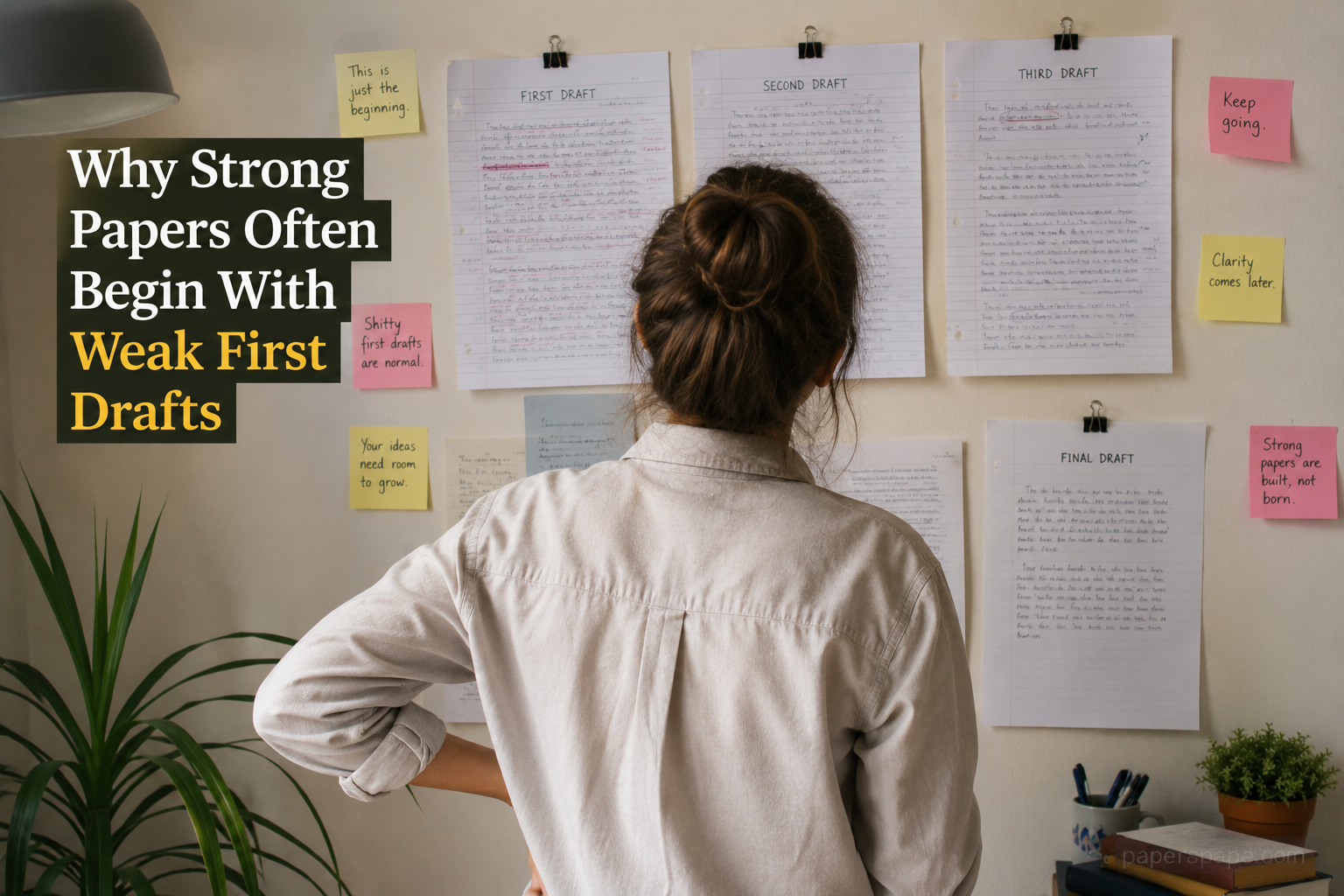
The reputation of the initial draft of an academic work is scary for many pupils. There is often a sense that each paragraph should sound polished, each source should slot in neatly and each argument should be persuasive from the outset. When reality doesn’t match that expectation, it’s easy to think something has gone wrong. In fact, many good papers start off as messy, repeated drafts that include parts that you will eventually discard.
An initial draft has a totally different aim from the finished form. This isn’t about showing off your writing skills; it’s about giving your ideas a place to be outside of your head. Until they’re written down, it’s difficult to see how thoughts join up, where evidence is missing or which areas need more attention. Editing before the manuscript is finished often slows down progress, because you begin to edit before your central argument has fully emerged. Experienced researchers and writers know this difference. They expect the initial draft to have difficult transitions, incomplete explanations, and paragraphs that will be revised. They do not regard these problems as failures but as useful signals that the article is starting to evolve. Each revision is easier because there is something specific to revise.
A Rough Draft Shows You Problems Your Mind Can’t
Often our ideas are clearer in our minds than on paper. When you put a logical argument into paragraph form, it can feel incomplete in your mind. You may find that two parts say the same thing or that an important link between ideas has not been made explicit enough.
This is one of the great advantages of writing an early draft. It shows up flaws when there is still plenty of opportunity to address them. Instead of guessing at the faults, you can pinpoint particular paragraphs that need greater proof, clearer examples, or better organization. Many students avoid writing because they intend to improve their thoughts by conducting more research. That helps sometimes, but just as often the missing pieces only emerge once a draft is in progress. Writing is not just the last phase of study; it is also a tool for discovering what needs improvement.
The Dangers of Perfectionism Can Stall the Whole Job
Perfectionism can appear in small ways. A pupil rewrites the introduction five times before going on to the second paragraph. Another spends twenty minutes seeking one perfect word instead of moving on with the argument. These behaviors might strengthen individual phrases but typically stop the document from evolving as a whole.
When you write every paragraph as if it must be ready for publication, progress is painfully slow. The writer continues to fine-tune areas that may ultimately be cut, moved, or cut. You work out the details before testing the general structure. Getting yourself to write imperfectly makes you move. When you have the main ideas on the page, you can look at them more dispassionately and determine which parts need careful revision. You are editing a whole argument, not individual lines; thus, the editing has more meaning.
Best ideas are often found in weak drafts.
Some of the best thoughts in an academic paper occur unexpectedly during writing. A paragraph that links two concepts together in a hurry can add an angle that will eventually become the main argument. A placeholder used as a temporary example may lead to a much stronger explanation later.
If you insist on writing only until you have everything perfectly thought out, you’re less likely to make these discoveries. Writing encourages thinking, and thinking often leads to better writing. It’s a two-sided coin. Thus experienced authors don’t criticize their initial drafts too harshly. They recognize that there may be good ideas in bad words or in a sloppy arrangement. A draft’s quality should be judged not by its first-pass polish but by its potential.
Revision is the Strength of Academic Writing
Many people think that successful writers write great papers the first time. In fact, frequently it is in editing that the true progress occurs. In revision, you replace poor evidence, clarify misleading explanations, eliminate excessive repetition, and make the overall argument more coherent.
This method is tough to do without a full draft. Once all the major sections are in place, it is much easier to assess the flow of a document, even if individual paragraphs still need a lot of work. This demonstrates how your ideas relate when transitions are absent and if your conclusion really represents the evidence offered throughout the work. The first draft is a chance for revision, and revision converts rough thoughts into a finished piece of academic writing. Great papers are seldom born in their full form. They are sculpted over time with significant improvements.
Before You Know All the Answers, Give Yourself Permission to Write
One reason first drafts don’t get finished is the belief that all questions must be answered before writing can begin. Good research is important, but waiting until everything feels complete will stall the entire endeavor. In fact, you often don’t see many gaps until you begin to articulate your ideas in whole phrases. Writing reveals lacking evidence, bad transitions and confusing logic considerably better than any amount of planning can.
This doesn’t imply writing without preparation. It means that it’s okay for your first version to have notes, temporary examples, or reminders to check a source later. These placeholders keep you moving yet provide a clear image of what still needs focus. You keep writing the paper, and when you go back to revise it, you return to those incomplete areas instead of stopping your progress every few minutes.
Focus on Completing the Draft Before Improving It
Students frequently revise each paragraph right after writing it. This seems constructive; however, it tends to create a pattern of polishing the beginning of the work and having the middle and end hardly exist. After you’ve rewritten the opening multiple times, your motivation is probably starting to diminish.
A better habit is to isolate drafting from editing. When writing your draft, focus on communicating your thoughts in the clearest way possible and don’t stress about precise terminology. After you’ve completed the full article, you may focus on organizing, reinforcing evidence, refining language, and addressing typos. Different stages have different goals, and progress usually moves faster when you keep them separate. Writers who write full drafts tend to rewrite more confidently, since they can see the paper as a continuous argument. Instead of striving to perfect individual pieces before understanding how everything fits together, writers are building upon an established structure.
How Different Approaches Affect the Writing Process
The way you treat a first draft has a direct influence on how smoothly the rest of the project develops.
| Drafting Habits That Slow Progress | Drafting Habits That Encourage Progress |
|---|---|
| Revises every paragraph immediately | Finishes the draft before major editing |
| Stops whenever a small detail is missing | Marks missing information and continues writing |
| Expects every sentence to sound polished | Accepts that early wording can improve later |
| Judges the draft by its appearance | Judges the draft by the ideas it captures |
Looking at the writing process this way makes it easier to understand why an imperfect beginning often leads to a stronger final paper. The first draft creates the foundation, while revision provides the refinement.
Before Calling Your Draft “Poor”
Before deciding that your first draft is unsuccessful, pause for a moment and ask yourself a few questions.
- Does the draft contain the main argument you want to develop?
- Have you identified areas where stronger evidence is needed?
- Can you see which sections require better organization?
- Is the overall direction of the paper clearer than it was before you started writing?
If you answered yes to most of these questions, the draft has already achieved its most important purpose. It has transformed scattered ideas into something you can evaluate, strengthen, and improve.
Every Paper Has an Unpublished Version
Readers only see the finished task. They don’t notice the paragraphs rewritten three times, the examples cut, or the arguments that entirely changed throughout revision. Almost every good academic paper has a successful draft that looks a lot less impressive than the final submission.
Coming to terms with this reality can alter the way you approach writing. You stop being afraid of a flawed first draft and start seeing it as a working document, not a final performance. That’s its worth. It helps you find better ideas, stronger proof, and clearer explanations as the project evolves. The purpose of a first draft is not to impress anybody. Its purpose is to provide your study a structure that can be enhanced through diligent revision. By not insisting on perfection right away, you will discover that your writing is more productive, your revisions more meaningful, and the road to excellent academic work much easier to follow.