
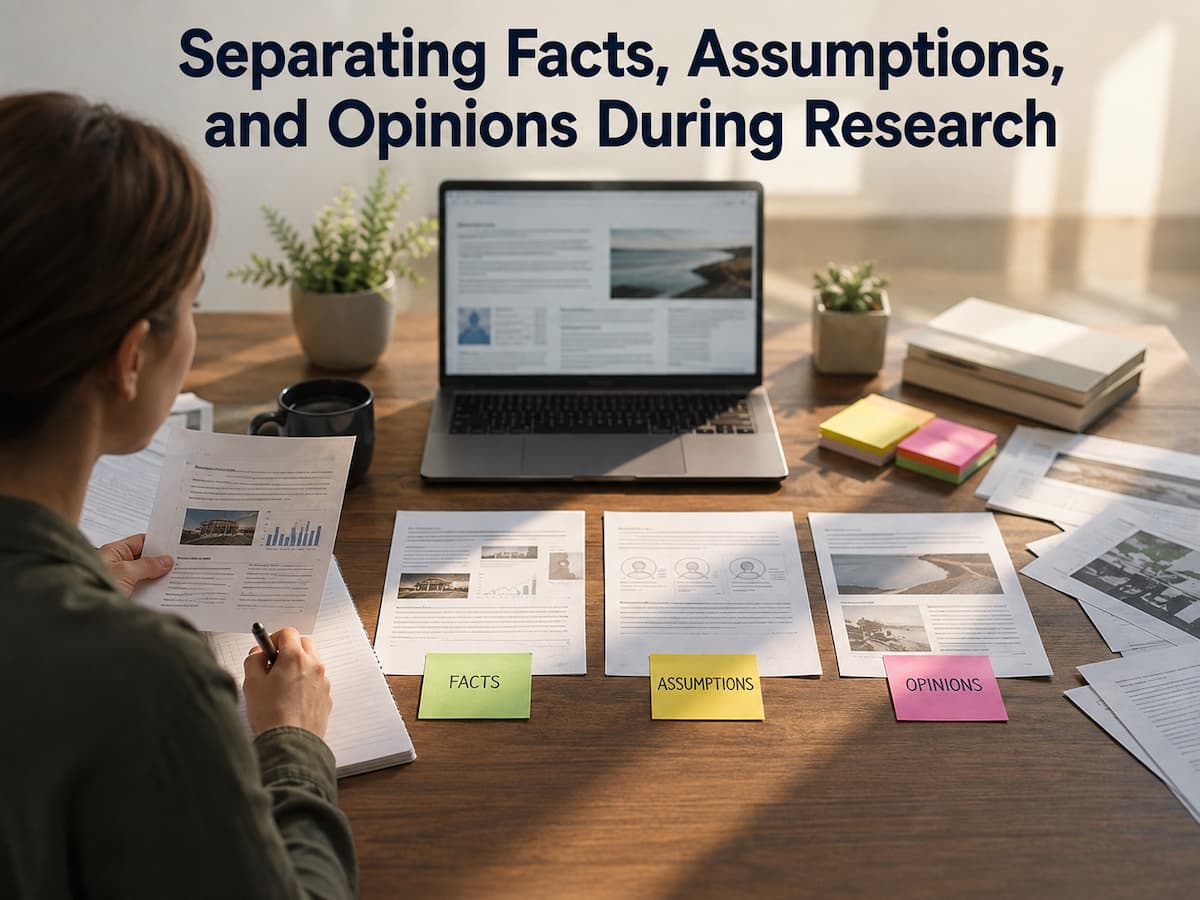
A simple question is often the start of research, but it quickly turns into a collection of articles, videos, reports, and talks that don’t always agree with each other. In different sources, you may discover that one says something is a proven fact and another says the same thing is unclear. Someone from a third source might strongly support one side without giving many facts. Such discrepancies can make it difficult for someone who is new to study to figure out what information they can trust and what they should be careful with.
The problem isn’t that most sources are trying to trick you. Instead, different types of information often become mixed together. It can be hard to tell facts, assumptions, and views apart when they all show up in the same paragraph. A news story might have both verified facts and the author’s interpretation of them. In a research report, the authors may state the results as “confirmed” before discussing possible reasons. Everyday conversations easily mix personal beliefs with things that people have noticed.
One of the most useful study skills is telling the difference between these three types of information. It helps you figure out what is known, what people think might be true, and what is based on personal opinion rather than evidence that can be checked. Recognizing these differences will help you think more clearly and come to stronger conclusions, whether you’re doing a school assignment, researching a new topic because you’re interested, or making a big decision.
Getting to Know What Facts Are
Many people think that study is just gathering information. In reality, research involves making sense of data, asking questions, testing ideas, and judging evidence. Thoughts and assumptions come up along the way because people are trying to understand what the facts might mean.
Let’s say you want to know why some students do better on tests than others. According to one article, students who go over their notes often tend to achieve better grades. If there is good evidence for this finding, we can accept it as a factual observation within the study’s limits. According to another article, students who do well are usually more motivated. That is an assumption if researchers haven’t directly tested it and shown it to be true. A third piece says that going over your notes is the best way to study. This statement shows an opinion because it contrasts one way of doing things with others using judgment instead of proof that everyone agrees on.
As you can see, these cases show that research is more than just reading carefully. It’s important to figure out what each statement does. It’s a lot easier to understand challenging topics once you start looking for the differences.
Understanding What Counts as a Fact
A fact is a statement that strong evidence can back up. Verification is what makes facts different from other kinds of information. If independent researchers, official records, or direct observation can back up a statement, it is a factual claim. Facts aren’t just numbers or new science findings. Dates, measurable events, written instructions, and observable conditions can all be facts. For instance, we can say that water freezes under certain circumstances because we can prove it over and over again. In the same way, formal records can be used to prove that a government released a report on a certain date.
People who are just starting out often forget an important point: facts can change when new evidence becomes available. This doesn’t mean that facts can’t be trusted. It means that study improves better over time. Sometimes, new evidence paints a more accurate picture than old information, which can lead to changes in what scientists know, how we understand history, and what doctors should do. This is why careful researchers don’t take every word that has been published as always true. Instead, they verify whether the best available data backs up the information.
Recognizing Assumptions Before They Influence Your Thinking
Assumptions are ideas that people believe without having full proof. They are often used to fill in gaps where evidence is thin or nonexistent. While some assumptions make sense and help researchers come up with theories, they should never be taken as proven facts. For example, someone might notice that a neighborhood library becomes busier when it stays open later. They might think that more people came because the hours were longer. This theory makes sense, but there are other things that could also be to blame. Maybe students in the area were encouraged to use the library more, or maybe new community events brought in more people.
The assumption is sometimes correct. When people stop treating it as an assumption and start treating it as a proven truth, that’s when trouble starts. A lot of the time, assumptions enter into research through everyday language. Words like “probably,” “must,” “clearly,” and “obviously” can be used to show that a conclusion goes beyond the facts. Using these words doesn’t always mean the reasoning is flawed, but they should make people think more about what evidence supports the statement. Good researchers don’t mind naming assumptions because it shows them where more study is needed instead of pretending that every question already has a full answer.
Opinions Play an Important Role—but They Are Different from Facts
People express their views, preferences, evaluations, or personal judgments through their opinions. Usually, opinions can’t be proven true or false because they depend on the person who holds them. One person might think that printed books are better for learning than digital books, for instance. For someone else, digital tools may be better because you can search them and take them with you. Either view can be backed up by personal experience or carefully chosen evidence, but that doesn’t make it a fact just because someone says it with confidence.
When opinions come from people with a lot of experience or knowledge, they are more valuable. A teacher with years of experience may have well-thought-out ideas about how students learn in the classroom. Even though those opinions are valid, they differ from proven research results. Many people become confused when someone presents opinions as if they were facts. This happens a lot in public arguments, product reviews, editorials, and social media posts. If readers always take strong opinions as facts, they might base their understanding on statements that lack support. Keeping the opinion separate from the evidence that supports it lets you value different points of view without mixing them up with known facts.
The Same Topic Can Contain Facts, Assumptions, and Opinions Together
One reason research feels challenging is that these three types of information rarely appear separately. A single paragraph may include all of them, requiring readers to identify where one ends and another begins.
Consider a discussion about remote learning.
“The school introduced online classes in September.”
This statement can be verified through official records, making it a factual claim.
“Students probably became more independent because of online learning.”
This sentence introduces an assumption. It suggests a possible explanation but does not yet provide direct evidence.
“I think online learning encourages better self-discipline than classroom learning.”
This statement expresses an opinion because it reflects personal judgment rather than a universally verified conclusion.
Seeing these distinctions in context helps develop better reading habits. Instead of accepting an entire paragraph as equally reliable, you begin evaluating each statement according to its level of support. This skill becomes especially useful when you read long reports, academic papers, or investigative journalism, where evidence, interpretation, and personal analysis often appear together.
Practical Questions That Help Separate Different Types of Information
Experienced researchers rarely accept information immediately. Instead, they ask simple questions that reveal what kind of statement they are reading. When you encounter a new claim, consider questions such as:
- Can this statement be independently verified?
- What evidence directly supports this conclusion?
- Is the writer explaining observed facts or interpreting them?
- Could another explanation fit the same evidence?
- Does this statement describe reality or express someone’s judgment?
- What information would strengthen or weaken this claim?
These questions slow the reading process slightly, but they significantly improve understanding. Rather than memorizing information, you begin evaluating it, which is ultimately the purpose of research. Over time, these questions become automatic. Instead of feeling overwhelmed by conflicting information, you naturally separate observable evidence from interpretation and opinion before deciding what deserves your confidence.
How Reliable Sources Help You Make Better Distinctions
Attention to source is one of the easiest methods to distinguish facts, assumptions, and views. Unreliable sources rarely clarify these disparities. They explain what is proven, uncertain, and interpreted instead of presenting every assertion with the same confidence. University research papers usually divide findings from debate. Research findings describe what was observed or measured. The discussion considers various interpretations for those outcomes. This framework emphasizes that evidence and interpretation are different.
Unreliable sources blur these lines. Blog posts may start with one correct fact, add multiple assumptions, and end with a strong opinion without indicating where they end. Readers may assume every assertion is equal since the writing sounds assured. It helps to look past the headline. Ask the source how it got its conclusions. References original evidence? Does it acknowledge ambiguity when needed? Trustworthy sources are frequently open about their ignorance.
Common Mistakes That Confuse Information
Sometimes careful readers combine facts, assumptions, and opinions. Our minds prefer rapid explanations over detailed evaluation, causing most blunders. A typical mistake is assuming repeated information is true. If multiple websites make the same claim, it may sound credible. However, those websites may be using the same incomplete or erroneous source. Familiarity is not evidence, but repetition increases it. Using confidence as proof is another mistake. Someone who sounds confident may be more convincing than someone who explains constraints. Confidence tells you little about a claim’s accuracy.
People also confuse connection with explanation. Say researchers find that bookworms do better on language examinations. That observation is true if supported by evidence. Assuming reading books alone increased scores may require more data. Study habits, educational chances, and reading skill may also contribute. Personal experience might sometimes confuse. If a method worked for one individual, they may think it will work for everyone. Their example is valuable, but not conclusive. Recognizing these patterns slows you down before drawing assumptions without proof.
Arranging Research Notes Without Mixing Information
Good research continues after reading a source. Organization of your notes greatly affects the quality of your conclusions. Many beginners write everything in one large document. Mixing facts, personal observations, quotes, and ideas. They can’t remember which information was from the source or which thoughts were theirs weeks later. Separating information while taking notes is better.
One section can contain verifiable data from trusted sources. Another may have unanswered questions. A third can be your interpretations or explanations. Reflections can be recorded separately from evidence. This simple habit avoids confusion later. It also simplifies writing because you know which claims need evidence and which are your analyses. Adding sources to factual notes helps too. Instead of browsing through dozens of publications, you may immediately find where the material came from to check a detail or revisit the context.
A Realistic Example of Separating Information During Research
Imagine you are researching whether studying outdoors improves concentration. After reading several sources, your notes might look something like this.
- Fact: A university study found that some participants reported feeling less mentally fatigued after spending time in natural environments before completing certain cognitive tasks.
- Fact: The study involved a specific group of participants under controlled conditions.
- Assumption: Reduced mental fatigue may lead to better long-term academic performance.
- Opinion: Studying outside is probably the best way for students to stay focused.
Notice how these statements differ. The first two describe observations that research can trace back. The third suggests a possible explanation but extends beyond what was directly measured. The fourth expresses a personal judgment by comparing one study method with others. If someone later writes an article claiming that outdoor studying always improves grades, they have moved well beyond the available evidence. Understanding these distinctions helps prevent exaggeration and keeps research accurate.
Why Good Researchers Are Comfortable With Uncertainty
Many beginners expect research to produce clear, final answers. Occasionally it does. Often, it doesn’t. Experienced researchers understand that uncertainty is not a weakness. It is an honest reflection of what the available evidence can support. Consider historical research. Historians sometimes disagree about why an event happened because surviving records are incomplete. Rather than pretending certainty exists, they explain which conclusions are well supported and which remain open to debate.
Scientific research works in a similar way. New discoveries occasionally challenge earlier explanations. Researchers revise their understanding because the evidence has improved, not because previous work was worthless. This willingness to adjust conclusions is one of the strengths of careful thinking. Instead of asking, “Is this absolutely true?” experienced researchers often ask, “How strongly does the current evidence support this conclusion?” That question encourages flexibility without abandoning standards for evidence.
Developing a Habit of Reading With Curiosity Instead of Agreement
One of the most significant changes that happens as your research skills improve is that you stop reading only to confirm what you already believe. Confirmation feels comfortable. We naturally pay more attention to information that agrees with our existing opinions. Unfortunately, this habit can hide important evidence that points in another direction. Curiosity creates a healthier approach. Instead of immediately deciding whether you agree with a source, ask what you can learn from it.
- Why does the author believe this?
- What evidence supports the conclusion?
- What questions remain unanswered?
- Could another explanation fit the same facts?
These questions encourage active reading instead of passive acceptance. They also reduce the chance of accepting weak reasoning simply because it aligns with your existing beliefs. Over time, curiosity becomes more valuable than certainty. It keeps your thinking open while still demanding good evidence before reaching conclusions.
Conclusion
Separating facts, assumptions, and opinions is not about becoming skeptical of everything you read. It is about understanding the role each statement plays within a larger piece of information. Facts provide the foundation because they can be verified through reliable evidence. Assumptions help explain ideas but require further testing before they can be treated as established knowledge. Opinions offer valuable perspectives, especially when they come from experienced individuals, yet they remain different from objective evidence.
As you practice identifying these distinctions, research becomes less overwhelming. Instead of accepting every confident statement as it is, you start asking better questions about where the information came from, how well it is supported, and whether the conclusion really follows from the evidence. This habit improves far more than academic work. It strengthens everyday decision-making, encourages thoughtful conversations, and helps you navigate a world where information is abundant but not always equally reliable. The goal is not to know everything. It is to understand what you know, what you only suspect, and what still requires further evidence before it deserves your confidence.
FAQs
1. How can I tell if a statement is a fact or an opinion?
Ask whether the statement can be independently verified through reliable evidence. If it can, it is likely a factual claim. If it reflects a personal belief, preference, or judgment, it is an opinion.
2. Can an assumption eventually become a fact?
Yes. Many assumptions begin as ideas that explain observations. If later research provides strong, repeatable evidence supporting them, they may become accepted factual conclusions within that field.
3. Why do reliable sources sometimes disagree?
Disagreement does not automatically mean one source is wrong. Researchers may interpret evidence differently, study different populations, use different methods, or simply have access to new information. Comparing their reasoning is often more useful than choosing the one with the strongest language.
4. Should I ignore opinions when doing research?
Not at all. Expert opinions can provide valuable insight, identify important questions, and offer practical experience. They simply should not be treated as verified evidence unless supported by reliable research.
5. What is the best way to improve this skill?
Practice regularly. Whenever you read an article, pause after important statements and ask yourself whether they are presenting a verified fact, making an assumption, or expressing an opinion. The more often you do these exercises, the more natural the process becomes.