
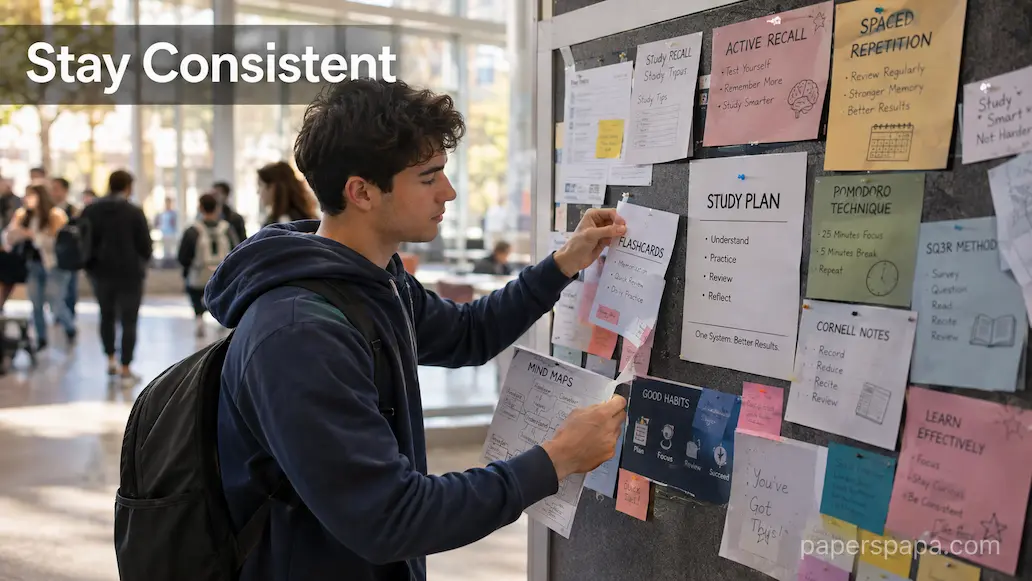
Many students try to find the ‘best’ learning method each semester. One week they create colorful mind maps, the next they watch videos about active memory. A few days later, they discover that flashcards or a new note-taking app work better. Trying out new methods is fine, but frequently switching them can lead to unexpected problems. Students spend time getting used to new methods, not on the learning itself and not on improving their learning efficiency.
In learning, perseverance is just as important as technique. You need to try out a learning method for a certain amount of time, understand how it works, how much time it takes, and whether it is suitable for your field of study. If you give up before you reach this stage, you will never know if it works. You end up in a cycle of constantly trying out new methods instead of making progress, because the learning process starts again after every new method.
Many similar suggestions can be found online, causing this pattern to become increasingly common. Students watch videos daily that claim to teach them to memorize faster, repeat more efficiently, or improve their learning efficiency. Some methods are indeed useful, but they can also create the impression that, to achieve success, you must constantly find new methods rather than improve existing ones.
Those who blindly follow the latest learning trends rarely become top students. Usually, they identify an effective method, adapt it over time, and continue using it, discovering which methods work and which do not. Their success is not based on constantly changing methods, but on continuous improvement.
Mastering a New Method Takes Time
Trying out new learning methods sounds appealing because it might lead to better results. However, many students forget that it takes time to adapt to a new method. You need to figure out how to organize your study materials, when to use the method, and which subjects benefit most from it. During the adaptation process, you learn the content and the method itself simultaneously. If you switch from an old method after just a few days, you have already wasted your money on the new system before you even see any results. You will have to go through a learning curve and a transition period again before you master the next method. Eventually, weeks pass, and you cannot use any single learning method often enough to experience the difference.
When you use a method repeatedly, you no longer have to make decisions, which makes you more efficient. Once you are familiar with a learning method, you can focus on understanding the content instead of figuring out how to learn.
Progress can Quickly Become Boring
Many students stop using a learning method simply because it is no longer fun. The first week, everything feels fresh and exciting. With new writing materials, new apps, or a new way of learning, you feel like a giant change is on the way. But after a while, the pattern becomes routine.
Some people think that this normal feeling of learning is a sign of failure, but it is actually just a sign that your method is starting to work. Long-term learning rarely offers daily excitement. Usually, the process means you have to practice useful skills repeatedly until they become second nature. Although the initial excitement may fade, the results are often better.
The right question to evaluate a learning method is not whether it is still fun, but whether it still helps you understand and remember what you have learned. This question is a better measure of learning success than short-term motivation.
Changing Your Study Methods Can Mask the Real Problem
Take, for example, a student who consistently struggles to remember biological concepts after exams. He tries handwritten notes, flashcards, video summaries, and eventually even electronic mind maps, believing that the problem lies in his study methods. However, his exam results remain largely the same.
The problem may not lie with his study methods at all. The student may have only reviewed once before the exam, neglected memorization exercises, or spent more time reading than practicing. Simply changing methods will not solve problems stemming from poor study habits. Any new method will ultimately lead to the same disappointing result because the real cause has not been found.
Before you decide to change your study methods, take the time to reflect on your current approach. A method you have mastered is generally more effective than one that is only partially used and constantly changing.
Ask Better Questions Before Switching
The next time you consider changing your study methods, take the time to reflect on it. Ask yourself if your current methods have been effective for long enough. You must consider whether you have used this method consistently, applied it to different subjects, and adapted it to your experience, rather than giving up when you encounter difficulties.
These questions encourage thoughtful improvements rather than hasty actions. They help you distinguish between methods that really don’t suit you and methods that simply need more time to show results. Small adjustments to an existing system often yield more progress than starting completely from scratch with a new method.
A Semester Reveals More Than a Single Week
Suppose two students start the new school year with the same goal: to improve their grades. The first student plans to try out a new study method almost every week. He spends a week making detailed flashcards, the next week taking long notes with summaries, and the third week using online productivity apps. At first, every method seems to work, but none can be sustained long enough to become a habit.
The second student chooses an effective study method and sticks to it for the entire semester. People do not blindly copy methods. When adjustments are necessary, such as reducing the number of repetitions, changing the study order, or adding practice questions for exams, they implement those adjustments accordingly. However, the fundamental learning methods remained unchanged. By the end of the semester, the second student had spent significantly less time adjusting his learning methods and significantly more time improving the learning content.
This example illustrates an important distinction: perseverance does not mean that progress stops. It means continuously refining existing methods, rather than constantly searching for new methods whenever a new idea arises.
Before You Try a New Learning Method
The next time you want to drastically change your learning style, take a moment to consider the following questions before making a choice.
Have you been using this method consistently for a few weeks? Have you also applied it to other subjects instead of judging it solely based on the difficulty level of one specific subject? And, more importantly, have you discovered which aspects are not working? If the answers to these questions are unclear, a hasty change can only make the situation more chaotic.
Sometimes it is better to stick to the basics and make only a few unique adjustments. For example, you could shorten your study time, repeat more often, or test your memory more instead of just reviewing notes. Because these changes build on existing habits, even small improvements can have a greater impact.
Not Every Useful Idea Needs to Become a New System
Teachers, classmates, books, and instructional videos often offer excellent advice. The misconception is that every good idea means you have to completely change your learning habits. Many practical tips can be integrated into your existing study methods without having to fundamentally change everything.
For example, you can continue taking handwritten notes and do a short memory game after every study session. You can stick to your existing study plan but do more practice exercises for the exam. These adjustments can help you learn better without having to start all over again with a study method that already works.
Think carefully before applying new study techniques. Good study methods improve over time, not by constantly coming up with new ideas.
Progress Comes From Improvement, Not Constant Replacement
It is easy to assume that the next learning method will eventually make everything easier. However, the best way to make long-term progress in your learning process is to understand your own learning habits, improve them gradually, and give effective techniques enough time to prove their effectiveness. In most cases, a system that improves a little every month is much more effective than a system that changes every few weeks.
The most effective learners are not necessarily those who master the most learning methods. They understand which methods help them to learn continuously, remember, and apply knowledge in the long term. Instead of blindly following new efficiency-enhancing methods, strive for a learning approach that can be continuously improved through experience. Steady progress, rather than always searching for the next ‘perfect’ method, is more likely to lead to long-term success.
Frequently Asked Questions
How do I determine if a study method is truly effective?
If you have been using a method for a while and adjusting it as needed, but it still doesn’t help you understand or remember what you have learned, you may need to try other methods. Do not conclude a study method based on just a few study sessions.
Do different subjects require different study methods?
Yes. For mathematics, regular practice exercises can be useful, but for history or biology, different revision methods may be needed. The goal is not to use the same method for all subjects, but rather to avoid changing study methods too often, so that you have enough time to develop habits.
Is it okay to try out different study methods?
Absolutely. Planned experimentation is an effective way to achieve good results. Implement only one major change at a time, observe the effects, and determine if it really helps with learning before implementing the next major change.