
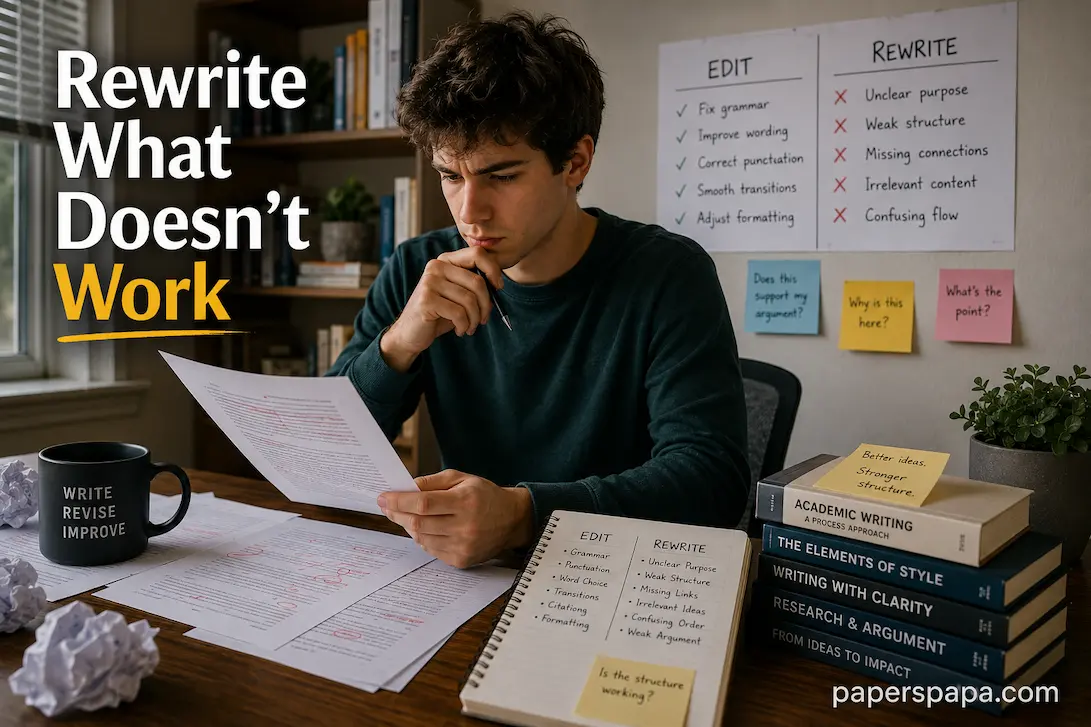
Every writer reaches a stage where a draft feels wrong, but the reason is difficult to identify. You correct grammar, improve transitions, shorten long sentences, and replace weak words with stronger ones. The document certainly looks cleaner than before, yet reading it still feels like hard work. Instead of flowing naturally, the paper seems to resist every improvement. This phase is often the moment when many writers continue editing, even though editing is no longer solving the real problem.
The difficulty lies in confusing two very different activities. Editing improves a draft that already has a solid foundation, while rewriting replaces parts of that foundation that no longer support the paper effectively. Both are valuable, but they solve different kinds of problems. Trying to edit a section that actually needs rewriting is similar to repainting a wall that was built in the wrong place. The appearance changes, but the underlying issue remains. Recognizing this difference can save a surprising amount of time. Instead of spending hours making tiny adjustments to paragraphs that still feel weak, you can step back and decide whether those paragraphs need to be rebuilt instead. Although rewriting may seem like more work at first, it often produces faster progress because it addresses the real cause of the problem rather than its visible symptoms.
The Same Paragraph Keeps Returning to Your Editing List
One useful warning sign appears when the same paragraph attracts your attention every time you review the paper. During one editing session you strengthen the wording. In the next, you reorganize the sentences. A few days later, you rewrite the opening line again because it still does not sound quite right. Despite all that effort, the paragraph continues feeling unfinished.
This usually happens because the weakness is not at the sentence level. The paragraph may lack a clear purpose, combine several different ideas, or rely on evidence that no longer fits the direction of the paper. Editing individual sentences cannot completely solve those issues because the structure itself has become the problem. Rather than making another round of small corrections, ask a different question: If I deleted this paragraph today, would I write it the same way tomorrow? If your answer is no, rewriting may be a better investment than continued editing.
When Better Sentences Cannot Save a Weak Idea
A paragraph can be beautifully written and still weaken the overall paper. Imagine a section that contains smooth transitions, accurate grammar, and polished language, yet discusses a point that no longer supports your research question. Strengthening the wording will never solve the deeper issue because the content itself has lost its purpose.
This situation often develops after research evolves. As your understanding of the topic grows, some early ideas become less important or even irrelevant. Writers sometimes continue polishing those sections simply because they invested time in creating them. Unfortunately, readers judge a paper by its current quality, not by the effort that went into earlier drafts. Removing or rewriting outdated material is a sign of improvement. It is a normal part of producing a stronger argument. Every experienced writer leaves behind paragraphs that once seemed essential but no longer belong in the final version.
Listen to the Questions You Keep Asking Yourself
While editing, pay attention to your thoughts. If you repeatedly ask whether a paragraph belongs where it is, whether readers will understand its purpose, or whether another example would entirely change the discussion, those questions deserve attention. They often point toward structural issues that sentence-level editing cannot resolve.
In contrast, questions about punctuation, wording, or citation style usually indicate that the draft is fundamentally sound and simply needs refinement. Learning to distinguish between these two kinds of questions helps you choose the right approach instead of treating every problem as an editing problem. Your uncertainty can therefore become a useful guide. Rather than ignoring it and continuing to polish the same page, treat recurring doubts as clues that a larger change may produce better results.
A Different Perspective: Imagine your draft was written by someone else, and you had been asked to improve it. Would you spend another hour replacing individual words, or would you recommend rewriting an entire section because its purpose is unclear? Viewing your work from that distance often makes the answer surprisingly obvious.
Stop Measuring Progress by the Number of Edits
Many writers assume that a document improves every time they make another correction. While that is sometimes true, the number of edits is not always a reliable measure of quality. You can spend an hour replacing words, adjusting sentence order, and refining transitions without making the central argument any clearer. A paper should be judged by how effectively it communicates its ideas, not by the number of revisions it has gone through.
When editing produces only minor improvements, pause before continuing. Ask whether the draft is becoming easier for readers to understand or whether you are simply changing details that have little influence on the overall message. That question often separates productive editing from unnecessary rewriting of the same sentences.
A Decision That Saves Time Later
Imagine you are reviewing a section that explains your main findings. The evidence is reliable, but the discussion feels scattered because you have combined several unrelated points into one long passage. You could spend the next hour improving individual sentences, yet the section would probably remain difficult to follow because the organization has not changed.
Instead, you decide to remove the entire section and rebuild it from the beginning using the same research. At first, the decision feels risky because you are deleting work you spent hours creating. However, the new version develops one idea at a time, the evidence appears in a more logical order, and the discussion becomes much easier to read. The total writing time may even be shorter because you stopped trying to repair a structure that no longer worked. Rewriting is often misunderstood as starting over. In reality, you are usually rebuilding with knowledge you did not have when the first draft was written. That experience makes the second version stronger from the very beginning.
A Quick Check Before Choosing Your Next Step
The next time a section feels weak, pause for a few minutes and think through these questions instead of editing immediately.
- Is the main idea of this section still relevant to my research question?
- Are the problems mostly about wording or about the organization of ideas?
- Would I keep the same structure if I were writing this section today?
- Have I already edited this part several times without noticeable improvement?
Answering these questions honestly often makes the next decision much easier. If most of your concerns involve the overall direction or purpose of the section, rewriting may achieve more than another round of sentence-level edits.
FAQs
1. Does rewriting mean my first draft is a failure?
Absolutely not. The goal of a first draft is to explore ideas and identify the best direction for the article. Rewriting usually indicates that you understand the subject better than when you wrote the first draft.
2. How do I avoid frustration after deleting a few paragraphs?
Remember that removing a section does not erase the underlying thought. The research, planning, and experience you gained while writing the first draft usually make the replaced content stronger and easier to develop further.
3. Do I have to rewrite the entire article if I feel a certain section isn’t perfect?
Usually not. Focus on the structural issues that stand in the way of clear argumentation. Many articles become stronger after rewriting one or two key sections.
Conclusion
It is all too common to fall into the trap of constantly revising drafts because rewriting seems like a waste of time. But in fact, it is often the opposite. Continuously updating a section that no longer supports your argument takes more time than rebuilding a section with a clearer purpose. Being willing to start over when necessary is not a weakness but an important part of effective academic writing.
With experience, you will become increasingly better at distinguishing between paragraphs that only require careful revision and paragraphs that need to be rewritten entirely. This distinction allows you to focus your time and energy on the parts where you can best improve your writing style. You will no longer need to revise dozens of times; instead, you will be able to write articles that are clear, well-substantiated, and persuasive. Subsequent revisions will then become meticulous refinements rather than reactive corrections.