
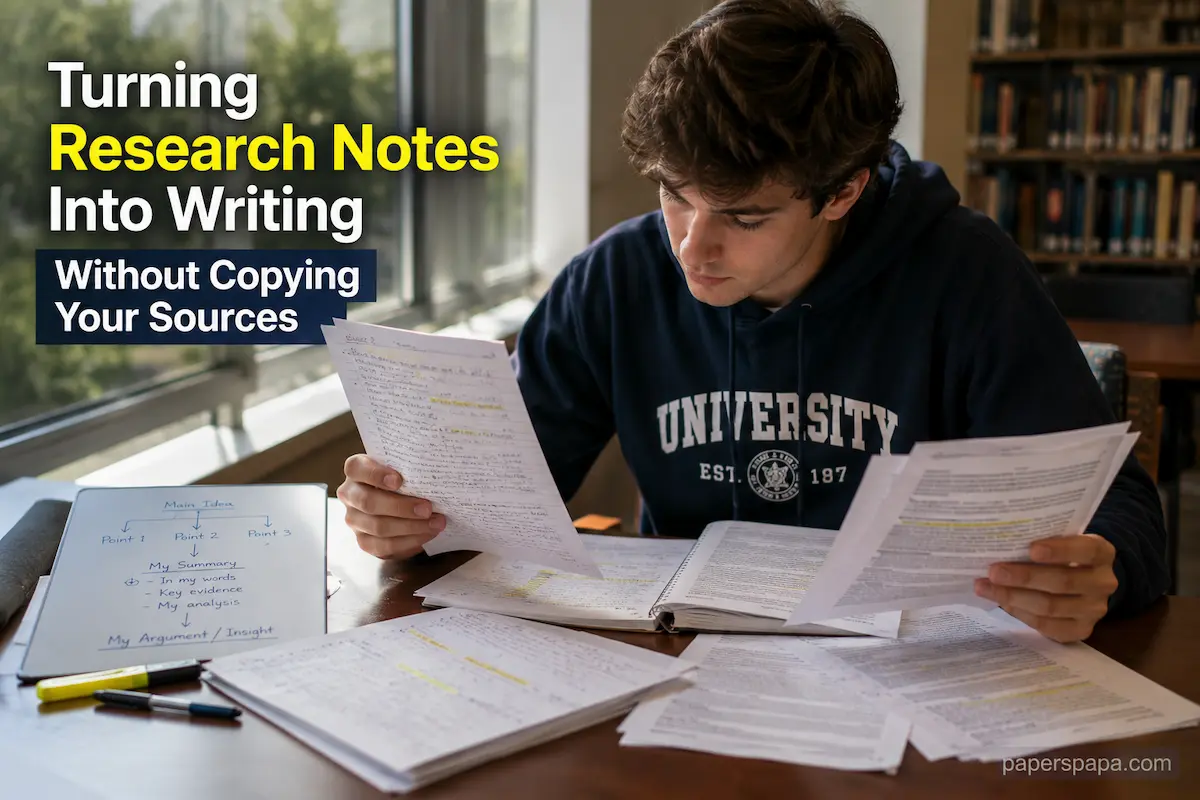
Although research notes are intended to facilitate writing, they often become a barrier for many students. After reading countless articles and highlighting key points, the writing process often begins with a blank page and a long series of seemingly unusable quotes. It is tempting to copy everything verbatim, because every sentence seems better than your words. Soon, the text reads more like a collection of other people’s opinions than original thought.
This problem does not always stem from a lack of writing skills. Usually, it is because there is no clear purpose when taking notes. You simply copy long passages verbatim from books, journals, or websites, instead of writing down your thoughts. After a few weeks, these copies become so familiar that they influence your writing style, but revising them becomes surprisingly difficult.
The quality of academic writing improves significantly when study notes demonstrate understanding rather than merely storing information. You should use notes to help you remember what a source has added, why it is important, and how it relates to your research question. Once you understand something, writing is not about repeating someone else’s sentences but about explaining ideas. The key is not to ignore sources. Reliable evidence remains fundamental to academic research. Your writing style should not let the original text dominate but rather lead the reader to the facts and help him or her understand the importance of each source.
Write the Idea Before Looking Back at the Source
A useful habit is to read a section of an article slowly, then put it aside and explain the points without returning to the original text. In the beginning, this can be more time-consuming, because you cannot simply copy sentences that sound good. But you must process information, not just copy text from one document to another, because that takes more effort.
When you write from memory, your understanding emerges naturally. You focus more on the meaning than on the exact wording the author uses. When you return to the original text later to review details or add citations where necessary, your draft will have its own unique style. This method also reflects your level of understanding of the subject matter. If you cannot explain a concept after reading a text, you would probably be better off spending more time understanding it before attempting to apply it in your work.
Not every important sentence needs to be in your notes:
Many research notebooks become filled with highlighted paragraphs and copied quotations because everything seems valuable while reading. The problem appears later when every page contains someone else’s wording and very little personal interpretation. Finding your own voice becomes much harder because the original text surrounds every idea.
Instead of recording long passages by default, pause and ask what you are likely to need when writing. In many situations, a short summary explaining the author’s main conclusion is more useful than an entire paragraph copied word for word. You can always return to the original source if you need the exact quotation later. This approach keeps your notes focused on understanding rather than storage. Instead of collecting large amounts of text, you collect clear explanations that are much easier to transform into original academic writing.
Your Notes Should Answer Questions, Not Just Preserve Facts
Imagine returning to your research notes after three weeks. If every page contains isolated facts, statistics, and quotations, you may remember very little about why those details were important. On the other hand, if your notes explain what problem the source addressed, what conclusion it reached, and how it supports your own research question, the writing process becomes much more straightforward.
Thinking this way changes the role of note-taking. You are no longer acting as a person copying information from one place to another. Instead, you are building a conversation between your sources and your developing argument. Each note becomes a reminder of how that evidence fits into the larger discussion. By the time you begin drafting, your notes already contain the foundation of your explanation. The research remains essential, but your interpretation becomes the part readers notice most.
A Habit Worth Practicing:
The next time you finish reading an article, resist the urge to copy the most impressive paragraph into your notes. Instead, write three or four sentences explaining what you learned and why that information is relevant for your paper. Afterwards, compare your explanation with the original text. You will often discover that your version sounds more natural because it reflects your understanding rather than the author’s exact phrasing. Over time, this small habit builds confidence. Instead of depending on borrowed language, you begin trusting your ability to communicate ideas clearly while still giving proper credit to the researchers whose work supports your discussion.
When Your Draft Starts Sounding Like the Article You Read
One of the clearest warning signs appears when you read your own draft and it no longer sounds like your normal writing. The sentences may be grammatically correct, but the wording feels unusually formal or closely resembles the style of the journal article you were using. This often happens without any intention to copy because the source remained open while the paragraph was being written. The ideas gradually become mixed with the author’s phrasing until the distinction is difficult to recognize.
A simple way to avoid this is to separate the reading stage from the writing stage. Spend time understanding the source first, then close it while drafting your explanation. After the paragraph is complete, reopen the article only to verify facts, page numbers, or quotations that genuinely need to appear exactly as written. This process helps your own voice remain at the center of the discussion while still maintaining academic accuracy.
Three Common Habits That Make Original Writing Harder:
Students often struggle to write naturally because of habits developed during the research stage rather than the writing stage.
- Copying long passages into notes without adding personal explanations.
- Keeping research articles open beside the document while drafting every paragraph.
- Saving facts without recording why they are relevant to the research question.
None of these habits automatically lead to poor writing, but together they make it much easier to rely on the original wording instead of developing your own explanation. Replacing them with thoughtful note-taking usually has a much bigger impact than trying to rewrite copied sentences later.
Think Like Someone Explaining, Not Someone Translating
Many writers unknowingly treat academic writing as a translation exercise. They read a paragraph from a source and then search for different words that express the same sentences. Although this may reduce direct copying, it rarely produces strong academic writing because the structure and flow still belong to the original author.
A more effective mindset is to imagine explaining the information to someone who has never read the source. What is the main point they need to understand? Which evidence matters most? Why is this particular finding relevant to your argument? Answering these questions naturally leads to writing that reflects your understanding instead of someone else’s sentence structure. When you prioritize explanation, your paper maintains a consistent voice throughout. Readers notice that the evidence supports your argument rather than replacing it.
FAQs
1. Can paraphrasing prevent plagiarism?
Not necessarily. Proper paraphrasing means reflecting your understanding of the text while retaining the original source. Simply changing a few words or rearranging sentences is usually not sufficient.
2. Should I use direct quotes?
Yes, but only when the phrasing is particularly important, such as unique definitions, impressive statements, or language usage that would lose its original meaning after paraphrasing. In most academic papers, explanation and analysis should take up more space than direct quotes.
3. What if I accidentally resemble the original too much?
Compare your draft to the original before submitting your paper. If the phrasing or sentence structure looks too similar, rewrite the paragraphs based on your understanding and ensure that the original quotes are correct.
4. How detailed should my research notes be?
Notes should contain enough information to understand the author’s key points, the main evidence, and the relevance to your topic. The purpose of notes is to help you remember the points, not to encourage you to copy the original text verbatim.
Good Notes Foster Original Thinking
Excellent academic writing begins before the first draft. It starts with reading, distinguishing truly important information, and capturing ideas in a way that promotes understanding rather than mere imitation. Well-prepared notes form a bridge between research and writing, reminding you of the contribution of each source without tempting you to copy the exact wording.
Over time, this approach also increases your writing confidence. You no longer feel that every important sentence must come directly from published literature but begin to believe that you can interpret the evidence clearly and accurately. Your research remains reliable, your citations remain rigorous, and your own reasoning connects all sources into a clear academic argument.