
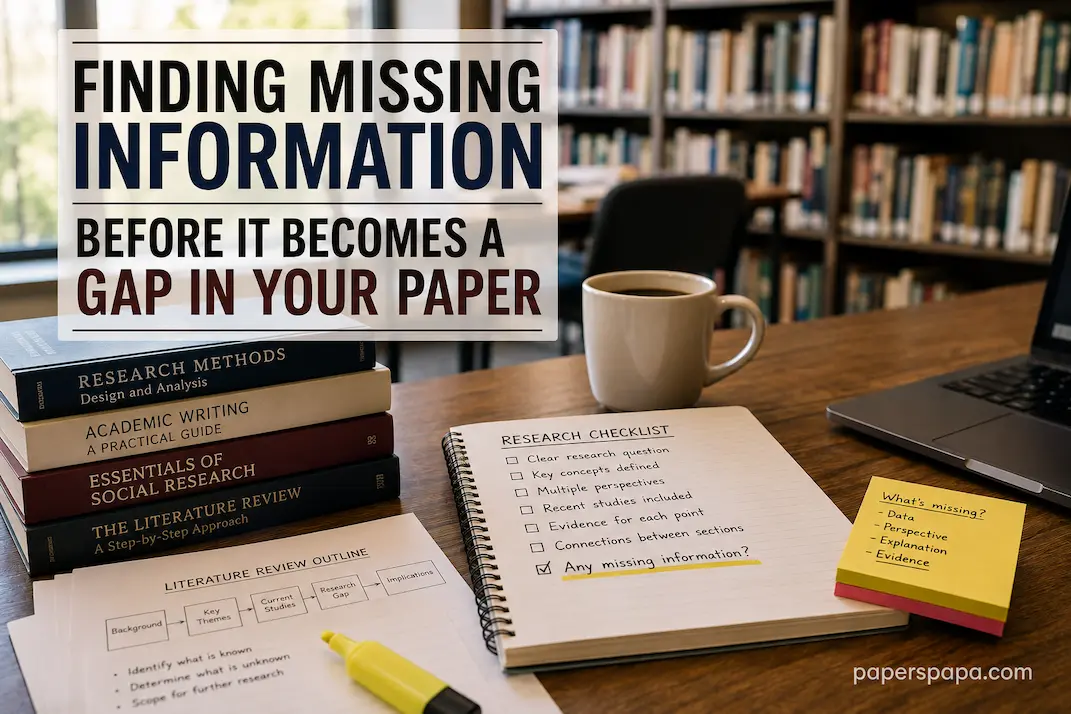
Completing your research does not mean you can immediately start writing your paper. One of the main reasons why academic papers feel unfinished is not spelling, grammar, or writing style. The real problem is simply that crucial information is missing.
Finding these missing parts is not always easy. Even with a wealth of scientific articles, notes, and diagrams, you might forget to include evidence that helps the reader understand your point. Sometimes descriptive sections are missing. Sometimes it is unclear why two studies yield different results, or the arguments lack sufficient substantiation. Often, you only discover these gaps during the writing process.
The problem is that correcting these errors after finishing the paper takes even more time. You have to put the manuscript aside, review your research, search for more data, restructure the article, and sometimes even rewrite entire paragraphs. What seemed like a nearly completed project now feels completely unfinished.
The way to break this vicious cycle is to learn how to find missing information before you even start writing. This enables you to continuously improve your research methods while maintaining clarity. This makes the writing process smoother, and the final paper will feel more complete rather than rushed.
A Full Folder of Sources Doesn’t Guarantee Complete Research
Many students judge the quality of their research by the number of articles they have read. A folder full of journal articles can be reassuring, as it suggests a wealth of information to refer to.
However, a large amount of material does not mean you have mastered all the information you need for your paper. You might find twenty excellent articles on the same subject but overlook another crucial point.
For example, you might encounter many studies discussing the benefits of online learning, but you may find few that discuss the disadvantages. Even with many arguments in your paper, readers may miss an important point.
Instead of wondering whether you have enough sources, check whether every point in your outline has sufficient evidence to support it. This question is often more effective for identifying missing information than simply counting references. Information gaps often exist between sections.
Missing Information Often Appears Between Sections
Their task is to locate sources for the introduction, conduct research for the literature review, and collect data for the discussion. Often, this method works, but occasionally it masks information gaps between the different parts.
Imagine this: the previous sentence ends with a discussion of the causes of the problem, while the next sentence begins with a discussion of how to solve it. Without explaining how these ideas are connected, people might think you have skipped an important step.
The same can happen during the transition from findings to conclusions. Even if every paragraph in a paper is well-written, the entire argument will seem incomplete if suggestions are made without explaining how the evidence supports them.
If you view your paper as a holistic discussion, rather than a series of separate chapters, it is easier to recognize these weaknesses before you even start writing.
Your Outline Can Reveal What Your Research Cannot
Many people use outlines as a writing aid, but they can also be an excellent way to test research findings.
First, write down the key points covered in each section of your outline. Do not add full paragraphs yet. Next, ask yourself a simple question: Have I found sufficient evidence for all these points?
This exercise can quickly help you identify your weaknesses. Some headings might have more than one reliable source, but others cite only one article or have no supporting evidence at all.
If you recognize these issues early on, you can revise them before the first draft and strengthen these sections. It is also easier to find research you have overlooked when your plan is still flexible than after you have already written many pages.
Pay Attention to Questions You Cannot Answer
When you try to talk about your research topic, that is a clear sign that you may be missing information.
Imagine presenting your paper to a classmate. Your initial ideas sound good, but then you might get stuck because you cannot answer a simple follow-up question. Researchers have reached different conclusions. Why? What is the evidence for this claim? Have the results changed since the last time such an event happened?
These moments are useful because they indicate exactly which aspects require further research. Do not view them as failures, but as opportunities to improve your paper before your readers encounter the same unanswered questions.
This is a common method experienced researchers use to test their understanding. If they struggle to explain part of an argument without consulting their notes, they know they may have gaps to fill.
Do Not Confuse Repeated Information with Complete Information
Reading a lot of literature on the same subject can make you think your research is complete. In reality, repeated information can simply mean that you have thoroughly investigated one area but neglected others.
For example, ten different articles might all conclude that effective time management improves academic performance. But if none of them explain why certain strategies are more effective than others, or discuss in which situations these strategies are ineffective, then you still do not fully understand the subject.
Good research examines the subject from sufficient angles to arrive at an in-depth discussion. It is not based on repeatedly presenting the same evidence.
If you want to write a balanced, well-substantiated, and informative essay, it is crucial to understand the difference between repeated evidence and complete evidence.
Check Your Work Before You Start Writing
Reading a draft before writing the first version is one of the best ways to discover gaps in the information. This approach might sound strange, but it can bring to light errors that are difficult to find when reading individual sources.
Review each part of your outline one by one. Imagine someone asks you to explain a section using only existing research. If you hesitate, make a guess, or realize that an important point is insufficiently substantiated, then you have found a gap that you need to fill.
This exercise is much more useful than simply going through your notes. The question is not what information you have, but whether it is sufficient to make your reasoning clear and convincing.
Identifying these weaknesses before you start writing can save time, because you can address the missing information immediately without interrupting your work.
Look for What Isn’t Being Discussed
Researchers naturally focus on the data they already have, but occasionally the most useful information actually comes from investigating what is missing.
Every source may discuss the benefits of a method, but rarely mentions the disadvantages. Much of your data may be from several years ago, meaning you may not have up-to-date information. Sometimes, people completely overlook different perspectives or important groups. Recognizing these gaps helps you avoid biased or inadequate presentations. It also prompts you to consider how to conduct research, rather than simply collecting studies that repeat what you already know.
Doing good research is more than just answering questions. Discovering which important questions still need to be answered is also a crucial part of research.
Compare Your Outline With Your Evidence
A useful way to evaluate your preparation is to compare your planned discussion with the evidence you have available.
| Part of Your Paper | What to Check Before Writing |
|---|---|
| Introduction | Can you clearly explain the topic with reliable background information? |
| Main discussion | Does every major point have enough supporting evidence? |
| Analysis | Can you explain why the evidence matters instead of simply describing it? |
| Conclusion | Do your findings naturally support your final message? |
If one section depends on assumptions rather than evidence, it deserves more attention before you begin drafting. A balanced paper is built by strengthening weak areas early instead of trying to fix them during revision.
Accept That Some Gaps Are Worth Keeping
Not every unanswered question is a problem. Some topics are still being researched, and complete answers simply do not exist. Trying to force certainty where the evidence remains limited can weaken your paper.
Instead, acknowledge those limitations honestly. If researchers disagree or if more investigation is needed, explain that clearly. Academic writing values careful reasoning more than pretending every issue has a simple solution.
Recognizing the difference between a genuine research gap in your own preparation and an unanswered question within the academic field is an important skill. One should be corrected before writing, while the other may become an interesting part of your discussion.
Final Thoughts
Missing information rarely announces itself. More often, it stays hidden beneath a collection of useful sources until you begin writing and realize that an important explanation, supporting study, or connecting idea is missing. At that stage, progress slows because the research process has to begin again.
Taking time to review your outline, test your understanding, and compare your evidence with the points you want to make allows you to identify these weaknesses early. Instead of interrupting your writing to search for missing information, you begin drafting with greater confidence because your research already supports the direction of your paper.
Well-prepared research is not defined by the number of articles you have collected. It is defined by whether your evidence is complete enough to guide readers from your introduction to your conclusion without leaving important questions unanswered.
Frequently Asked Questions
How can I tell if my paper has a research gap?
A research gap often appears when you make a claim but cannot support it with reliable evidence, or when readers would naturally ask a question that your paper never answers.
Should I keep researching until every question is answered?
No. Some questions remain unresolved even in published research. Your goal is to gather enough reliable evidence to support your discussion while acknowledging areas where knowledge is still developing.
Can an outline really help identify missing information?
Yes. An outline makes it easier to compare your planned arguments with the evidence you have already collected. Weak sections usually become much easier to spot before writing begins.