
Research projects usually take more than a week to complete, from the initial research to the final article. Some tasks can take a semester. Dissertations, graduation theses, and long-term projects can even take months. During this time, your database of journal articles, books, reports, and online material grows exponentially. At first, everything seems well organized because you still remember exactly why you saved each document. But the real challenge often comes later.
Imagine opening your research folder much later. It contains dozens of PDF files with titles such as ‘Final Version’, ‘Article 2’, ‘Downloaded Articles’, and so on. You remember several titles, but you can no longer recall which study contained the necessary figures, which article refuted your arguments, or why you saved half of the files in the first place. Your database, instead of helping you pick up your project again, has become a new problem that you have to solve.
This situation occurs more often than many students realize. A database is more than just a repository for research material; It is a resource that must retain its value throughout the entire lifecycle of your project. If you still haven’t organized your database months later, the time you spent collecting all that material loses its value.
The good news is that you don’t need expensive software or complicated processes to create a valuable database. The key is systematic practice, not advanced tools. A little organization today can save you hours of wasted effort tomorrow.
Save Material for a Reason, Not Just Because It Seems Useful
Saving articles without a clear purpose is one of the fastest ways to turn your research database into a mess. In the early stages of research, almost every article seems interesting. Many students download these articles “just in case” without seriously considering whether they are actually relevant to their research project.
A few months later, these files will result in unnecessary work. You will have to open every article again and ask yourself why you saved them in the first place, whether they support your topic, and whether they are still worth keeping for your research. A better habit is to understand the purpose of a source before adding it to your database. It may contain background information, explain key concepts, introduce the latest findings, or offer a different perspective than other researchers. This information makes it easier to quickly identify sources.
Every article you save is like adding a team. If it does not have a clear role, it generally does not belong.
File Names Are More Important Than Most Students Realize
Research folder names such as ‘Research Articles’, ‘New Articles’, or ‘Downloads (5)’ are common. These labels may seem harmless when the files have just been downloaded, but they almost lose their meaning over time.
Clear file names are crucial. Include the author’s last name, the publication year, or a descriptive phrase so you can identify the source without opening the file. Even months later, you can immediately understand the content of any document.
Effective naming habits also reduce the chance of saving duplicate files. File names let you know immediately if you have downloaded a study, without having to guess.
Good habits start even before you start writing. Even something as simple as a descriptive file name can save countless hours on a long-term research project.
Sort by Purpose, Not by Publication Type
Many students create folders for things like books, journal articles, reports, and websites. That is understandable, but it often makes retrieving information during the writing process more difficult.
When you start a chapter on your research results, you might no longer remember whether the information comes from a report or a journal article. What you usually do remember, however, is its role within the project.
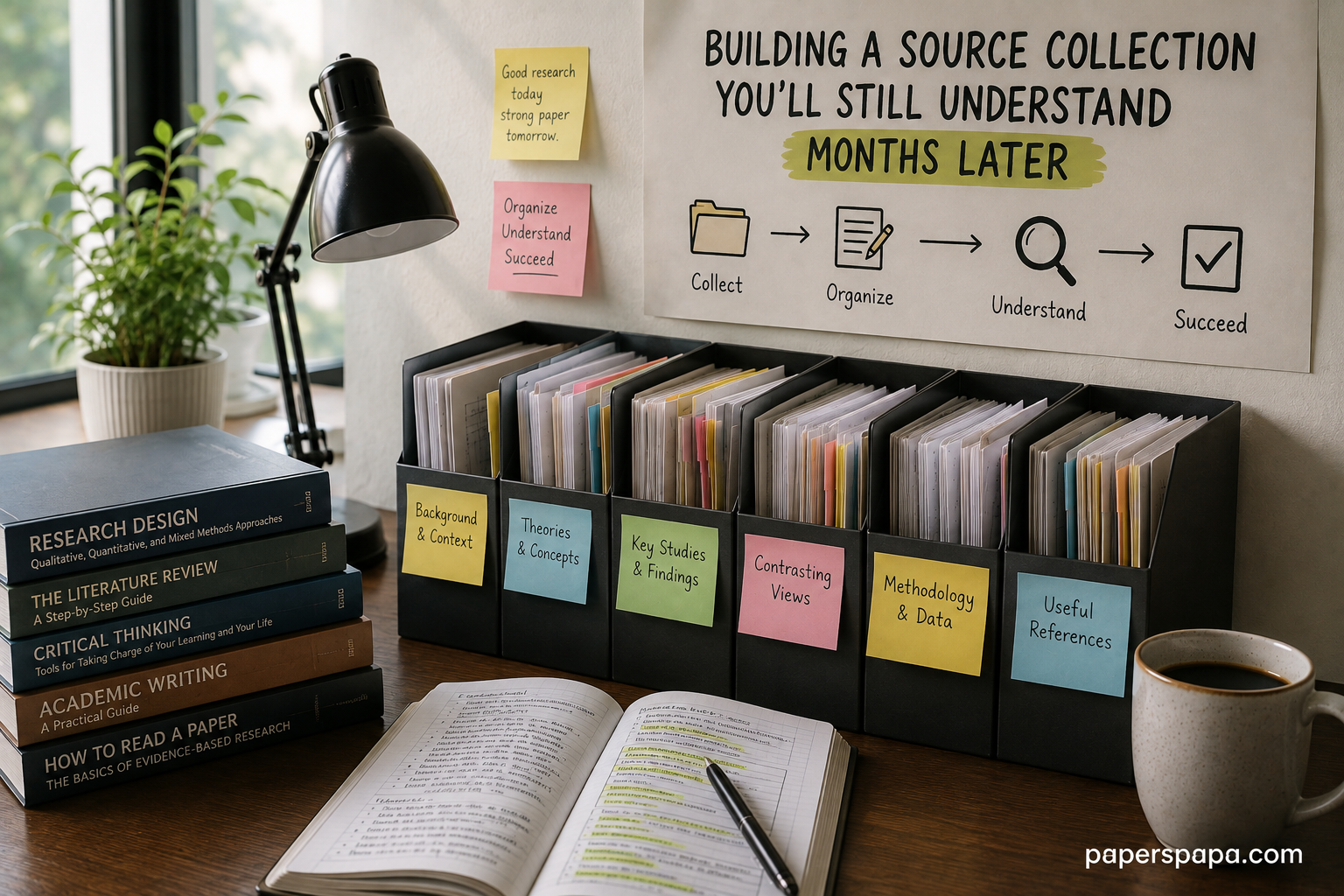
A more effective approach, however, is to organize the material based on its function within the project. For instance, one folder might contain background literature, another theoretical material, yet another recent research, and another material with various perspectives.
This way of organizing reflects your thought process while writing. You do not have to read every article; instead, you can decide what you want to convey.
Provide Cues Early in the Reading Process
The best time to explain the importance of a piece of material is immediately after reading it. If you wait until later, you will almost certainly forget several details. After reading an article, briefly summarize its value in a few sentences. You can note the key findings, the limitations mentioned by the author, or indicate which chapter or section of your article the article connects to.
These notes do not need to be long. Even three or four lines can still make the article understandable months later.
Consider these notes as a guide for yourself in the future. They save you the trouble of rereading every article and remembering why you collected them.
A Concise Source Library Is More Valuable Than a Huge One
Sometimes students feel successful because they have hundreds of sources in their binder. A large source library might seem impressive, but it is not necessarily useful.
Libraries that are too large often contain duplicate information, outdated research, and randomly added material that has never really been studied. As the library grows, it becomes increasingly difficult to identify truly valuable sources.
Well-chosen, well-known sources are often more effective. Each source serves a clear purpose, which accelerates research evaluation and significantly simplifies the writing process.
Our goal is not to build the largest source library ever, but rather a clear, relevant, and effective source library that remains relevant from the start of the project to final publication.
Update Your Source Library As Your Research Progresses
Research projects rarely stand still. The more you read, the better you understand the subject matter, and the more focused your research can become, while the importance of some earlier sources may gradually diminish.
Therefore, never view your database as a one-off solution. It is best if it grows with your project. Take the time every few weeks to review your collected material. You may notice that some articles are no longer relevant to your goals, or that multiple sources cover the same subject.
By deleting or updating these files, your database remains current. This way, you do not have to search through dozens of redundant documents to have a streamlined database that represents your current research topic. Regular maintenance might seem time-consuming and laborious, but it saves you a lot of hassle when deadlines are approaching and every second counts.
Make Retrieving Information Easy and Convenient
Many students remember excellent explanations or useful statistics but can no longer recall where they saw them. Half an hour later, they are searching through all the documents before finally finding the right page.
You can prevent such confusion by making simple reference marks while reading. Do not write long summaries; instead, note details to find information quickly. For example, mark a main theme, an important point, or a section of the material you expect to use.
These little reminders act as signposts. Months later, when you open your database again, you won’t have to start all over again. You will know which materials are worth looking at and which you can ignore.
The faster you have access to materials, the more time you can spend thinking about arguments instead of struggling through documents.
Remove Your Material Without Hesitation
Researchers are often reluctant to discard literature because they think they might need it later. Therefore, they continue collecting documents until dozens pile up, but not a single document is usable.
In fact, you will find that removing unnecessary material often improves the quality of your research. If a document is outdated, duplicates existing information, or is no longer relevant to your research question, keeping it only leads to more redundancy.
Removing a document does not mean that your previous efforts were in vain. Perhaps that article helped you understand a topic, but it is not suitable for your final research project.
A well-maintained database is not about the quantity of documents, but about how quickly you can find relevant evidence when you need it.
Compare Two Different Approaches
The way you manage your research collection has a direct impact on how easily you can return to it after a long break.
| Unplanned Collection | Well-Maintained Collection |
|---|---|
| Files saved with unclear names | Files named clearly and consistently |
| Articles collected without a specific purpose | Every source has a defined role in the project |
| Duplicate or outdated material remains | Unnecessary sources are reviewed and removed |
| Difficult to restart after several months | Easy to understand even after a long break |
The difference may seem small while your project is active, but it becomes very noticeable when you revisit your research weeks or months later.
A Few Habits Worth Keeping
Long-term organization is usually the result of small, repeatable actions rather than one perfect system.
Consider building habits such as:
- Renaming files as soon as you download them.
- Adding a short note after finishing each important source.
- Reviewing your collection at regular intervals instead of only before deadlines.
- Keeping only the most relevant version when several sources say the same thing.
- Checking occasionally whether your collection still matches your current research question.
None of these habits require much time, yet together they create a research library that remains useful throughout the entire project.
Frequently Asked Questions
Do I need special software to organize research sources?
No. Many students successfully organize their research using regular folders and documents. The system matters less than keeping it consistent and easy to understand.
Should I keep sources that I probably won’t cite?
If a source has helped you understand the topic, you can keep it in a separate reference folder. However, your main research collection should focus on sources that are genuinely relevant to your project.
How often should I review my source collection?
There is no fixed schedule, but reviewing it after completing a major section of research or every couple of weeks helps prevent unnecessary clutter from building up.
Is it worth renaming downloaded PDF files?
Yes. Clear filenames make it much easier to recognize and locate sources months later without opening every document individually.
What if my collection is already disorganized?
Start with small improvements instead of rebuilding everything. Rename important files, remove duplicates, and add short notes to your most valuable sources. Even gradual changes can make your collection much easier to manage.
Final Thoughts
A research collection should continue helping you long after the day you save your first article. If reopening your files after several months feels confusing, the problem is usually not the amount of research you completed but the way it was organized.
Creating a collection that remains useful requires simple, consistent habits. Save sources with a purpose, give them meaningful names, leave yourself helpful notes, and review your library as your project develops. These small actions make returning to your research much easier, whether you step away for a few weeks or several months.
The best source collection is not the one with the most documents. It is the one that allows you to find the right information quickly, understand why each source matters, and continue writing with confidence whenever you return to your project.